Basic info for the day
- Morning ride by Bernina Bus alongside Lake Lugano and into Italy along the northern shore of Lake Como, then through the extensive Veltlin vineyards to the Italian border town of Tirano.
- Bernina Express train along the UNESCO World Heritage-listed Bernina Railway line; scenic narrow valley terrain with many switchbacks to gain altitude from 400 m (1’200 ft) up and over the 2'253 m (7’300 ft) Bernina pass summit.
- Distance is 122 kms (76 miles) through 55 tunnels and over 196 bridges and viaducts.
- Cross the language border between Italian and Romansch with different cultures and cuisines.
The Bernina Train Route
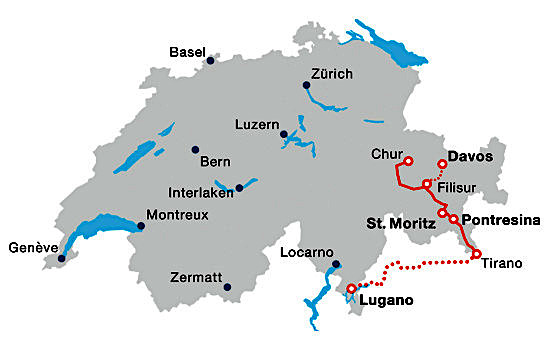
Tirano (Italy) to St Moritz
The Bernina Express is a railway journey with exceptional scenic views. Keep watching out both sides of the train as the views switch from one side to the other with each loop and turn of the train.
This railway is one of 3 railways in the world with "UNESCO World Heritage" status - a tribute to the skill of the railway engineers and builders of the 19th century.
It is the highest “adhesion railway” in the world; the line takes the trains from 400 m (1,200 ft) up to 2,253 m (7,300 ft) and back down again, all without the use of a cogwheel system. In order to achieve this, the route was designed so that it contains many switchback turns and spiral loops in order to gain height in a steady climb.
The route goes through forest and up above the tree line to bleak Alpine landscapes. In some places the train rides on the street, blocking it completely because there is not enough space for both a road and a railroad. It is the only train that crosses the Alps without going through very long tunnels.
The significance of the railway for the local economy was substantial. It opened up secluded valleys to the world and even allowed the first TB sanatoriums to be built. The wild romantic landscape and the quality of light inspired creative works by authors and particularly by painters.
Do not miss these features of the Bernina route!
Glaciers
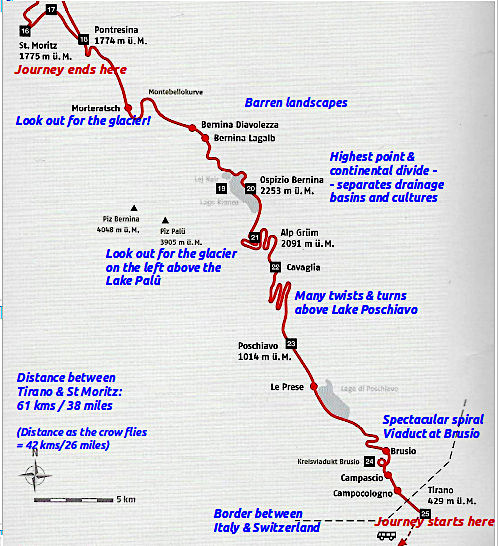
Just before the Alp Grüm station, the first of the mighty glaciers comes into view on the left - the Palü glacier below the Piz Palü peak.
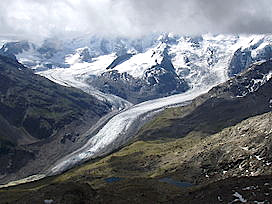
Just before the town of Pontresina, on your left, look out for the Morteratsch Glacier sweeping down from the Bernina mountains.
Watershed between East and West flowing rivers
Soon after the Ospizio Bernina station, the highest point on the route at 2,253 m (7,391 ft), the Lago Bianco (White Lake) will come into sight.
As you travel along the its shore, look out on the left hand side for the yellow signboard that marks the watershed between the rivers flowing south-west towards the Adriatic and those flowing east towards the Black Sea.

Circular Viaduct at Brusio
About 10 mins after departure from Tirano, you reach the spectacular Brusio circular viaduct with two 360-degree loops that allows the train to gain altitude in a small area at a steady 7% gradient, the maximum gradient before the trains would slip on the ascents or descents.

Key info on ST MORITZ
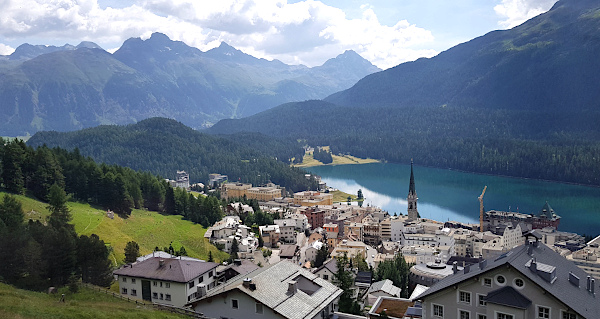
One of the most famous resorts in the world with a name and logo protected as a trademark since the 1930s.
Twinned with Vail, Colorado.
Population - approx. 5'600 (permanent pop)
Situation - at 6,000 ft; sub-arctic climate; claims to have average of 322 days of sunshine per year.
Named after Saint Maurice, an early Christian saint martyred by the Romans in the 3rd Century; credited with bringing Christianity to Switzerland.
1864 - Winter tourism in the Alps began when hotel pioneer Caspar Badrutt bet wealthy summer guests that they would find winter in St. Moritz as attractive as in summer. They did!
Claims many "firsts" - first tourist office in Switzerland, first electric lighting, first bob run, first ski school in Switzerland.
St Moritz today - Winter attracts the jet-set; Summers attract top sportsmen & women who come for high altitude training.