
Origins
1847 - Switzerland got its 1st internal railway line - the Swiss Northern Rail's 16 km line between Zürich and Baden. Private companies—led by Swiss entrepreneurs, industrialists and bankers such as Alfred Escher —built the next wave of railways.
1848 - after a short civil war, the new Confederation of Switzerland was formed.
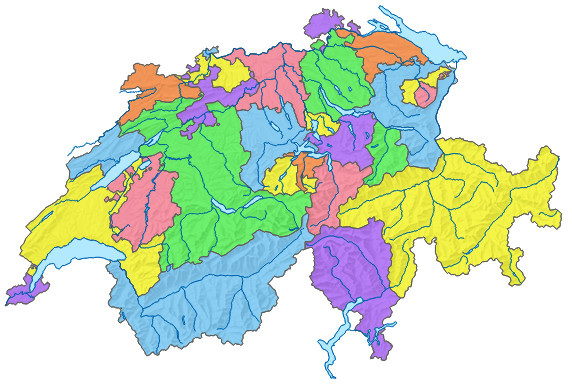
Illustration of Swiss cantons
The newly installed Federal Council recognised the need for a national rail network and in 1850 it commissioned British railway engineers to draw up a master plan for railway development in the country. However, the 1st Railway Act of 1852 gave responsibility to create own local railways to the cantons.
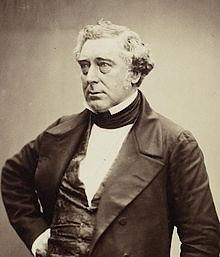
Leading British railway engineering expert, Robert Stephenson (son of George) and his colleague Henry Swinburne, were commissioned to draw up plans for a national railway network for the Swiss Confederation.
Stephenson & Swinburne proposed a basic 645 km network with an East-to-West line along the valleys between Geneva and Zürich, plus another line from Basel to Lucerne. They avoided any Alpine crossings due to the technical difficulties of traversing high stretches and deep valleys.
The Stephenson--Swinburne plans form the backbone of today's rail network.
Their influence also meant that the Swiss adopted the the Stephenson & Co. “standard” gauge (4 ft 81/2/in/1,435mm) as the national gauge, and instituted British-style left-hand running on double-track lines.
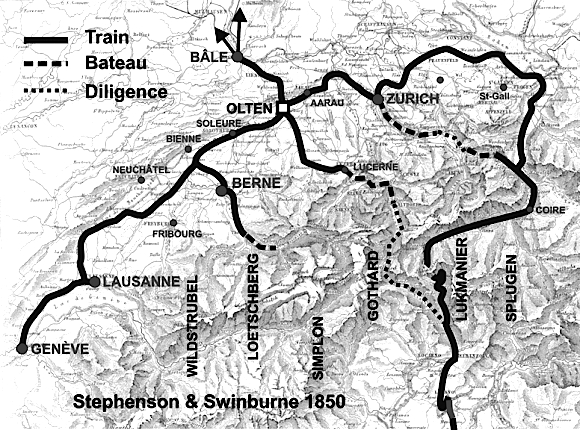
Railway lines were rapidly laid following the Stephenson & Swinburne plan and many competing railway companies were founded, often combining lake steamship and horse-drawn carriage services together with their rail network to offer travelers a complete package.
By 1860 railway lines covered the northern part of the country from the French border at Geneva to the Austrian border at St Margarethen.
The railroads quickly became a unifying force and a vital part of the nation's prosperity.
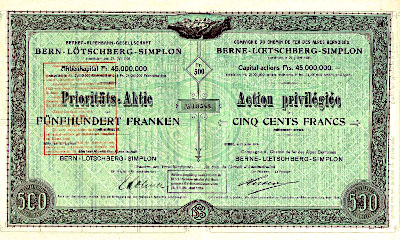
Railways share certificate
1872 - Railways policy becomes a Federal duty
Learning from the problems the private railways were faced in moving troops quickly during Franco-Prussian War (1870-71), the Swiss government removed the powers of the cantons to make railway policy and made it at federal level - in the 2nd Railway Act 1872.
Thereafter the construction, operation, tariffs and accounting of the railways, and the licensing of railway companies was transferred from the cantons to the federal government.
It also allowed local and mountain railways to be built with narrow gauge more suited to rugged mountain terrain and to lower costs.
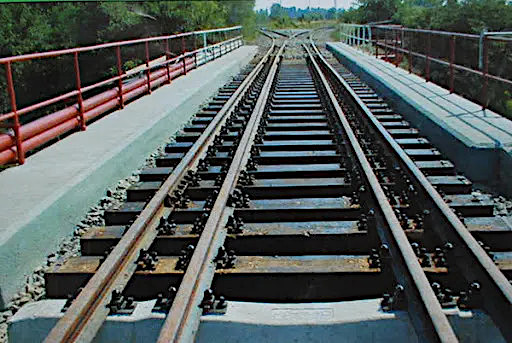
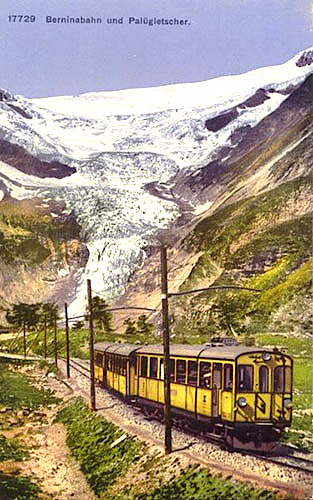
Railways and Tourism
The rapid expansion of tourism at the end of the 19th century contributed greatly to rail development with many lines constructed to cash in on the tourism boom.
In 1871 the Rigi Railway opened the first cogwheel train in Europe. Wealthy British tourists began to invest in mountain rail companies, and built hotels to service their sophisticated requirements, helping Switzerland to become a favourite holiday destination for a new breed of travellers.
Tourism also contributed to the standardisation of timekeeping throughout the Swiss Confederation through the introduction of train timetables since at that time Switzerland was divided into different time zones.
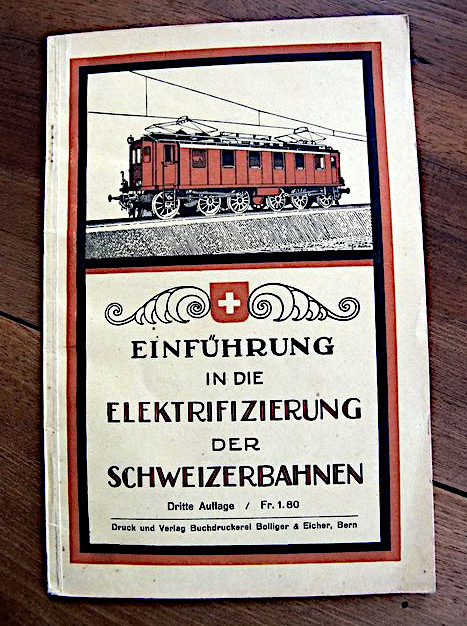
Electrification of the network
Electrification started on an experimental basis in 1888 and was completed in 1960. It was accelerated as a result of coal shortages during the two World Wars.
By the beginning of World War II, 77% of the Swiss rail network had been electrified, while other European railways had a level of electrification of 5%.
Switzerland became the largest European market for large electric carriages while other countries hesitated with the conversion, or even reversed it. Swiss-designed machines found recognition worldwide and brought in significant export orders.
By 1960 Swiss railways became the first country in the world to achieve the close to full electrification.
Alpine railway crossings
By 1870, northern Switzerland had a significant network of railways with links to the adjoining railways of Germany and France. But no line had yet been laid through the Alps to southern Switzerland and Italy. All North-to-South rail traffic had to pass either to the West or East of Switzerland through France or Austria.
Laying a railway through the Alps became an obsession for many politicians as a shorter route and faster journey time would avoid the narrow, winding routes over mountain passes, often closed in the winter. For engineers, the technological challenge became a powerful driver of innovation in engineering.
Many routes through the Alps were proposed; in the end, after securing financial backing from Germany and Italy, the Swiss Federal Council selected the ancient route through the Gotthard Massif that pilgrims and traders had used since the 13th century.
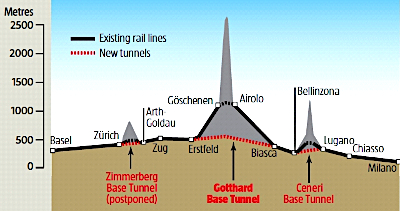
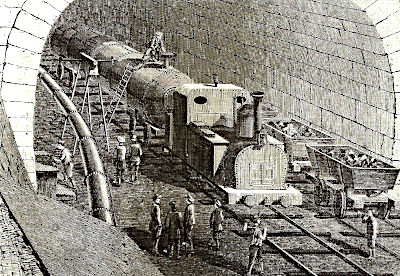
After 10 years of construction, the first railway line to cross the Swiss Alps, the Gotthard Route, was completed in 1882. The line necessitated the construction of 36 tunnels, including the world's longest railway tunnel at the time at 15 kms/9 miles, and the building of 1,234 bridges and open galleries. The tunnel's construction proved particularly difficult due to technical, geological, and financial factors.
New technology, such as air-pressure drilling machinery and dynamite blasting, was used during construction. However, the working conditions were so bad that 177 workers lost their lives during the construction of the main tunnel alone.
After the immediate success of the Gotthard Railway line and its Gotthard Tunnel, other trans-Alpine railways were laid - the Simplon in 1907, the Lötschberg in 1913, being the main routes that link Switzerland with neighbouring countries.
During the 2nd World War, the Swiss Alpine rail crossings represented a vital trump card of Swiss foreign policy.
The Germans and Italians relied on these lines for their non-military transports. If Switzerland came under attack, it had the option of blowing them up immediately.
Nationalisation and creation of the Swiss Federal Railways
After the initial railroad boom of the late 19th century, some speculative railroads went bust and many Swiss became disenchanted with their railroads being largely owned and operated for the benefit of foreign shareholders.
Various factors - strikes, bankruptcies of private rail companies, anger at foreign ownership of the railways - led to public support for nationalising the railways.
Several referendums were held.
The 1898 referendum was decisive attaining the highest level of voter participation to date.
As a result, the Swiss Confederation began buying out railway companies and by 1909 had consolidated them into the Swiss Federal Railways.
