The education system in Switzerland is very diverse - due to the different languages and the long history of cantonal independence.
The Swiss Constitution sets the basic foundations and expectations - compulsory 9-11 years of free schooling for every child, with responsibility for the administration of education and training decentralised down to the 26 cantons.
Key principles that characterise Swiss education philosophy:
Education is free - it is regarded as the government's duty to use taxpayer money to ensure that future generations are appropriately educated and trained. A minimum of 9 years of compulsory schooling is free in all state schools; universities and colleges are also essentially free - to ensure that everyone, provided they meet the minimum academic standards required, and regardless of socio-economic background, has the opportunity to study further. It is firmly believed that no young person should start off their working life having to pay off a large education loan as this only perpetuates the divide between the wealthy and the less well-off.
Teaching is a status profession - teachers are well paid and well respected; this attracts men to the profession ensuring that it does not become too female-dominant and therefore of lower status and pay.
School administration is at local level with close collaboration between school and parent body. All children, regardless of socio-economic background, go to the same school in the village or suburb. Each school has an elected body of parents who work with the school administration to ensure standards are maintained.
Flexibility and multiple ways of reaching full potential for everybody - recognising that one size does not fit all - some students require more time to reach a goal than others, but all get there in the end.
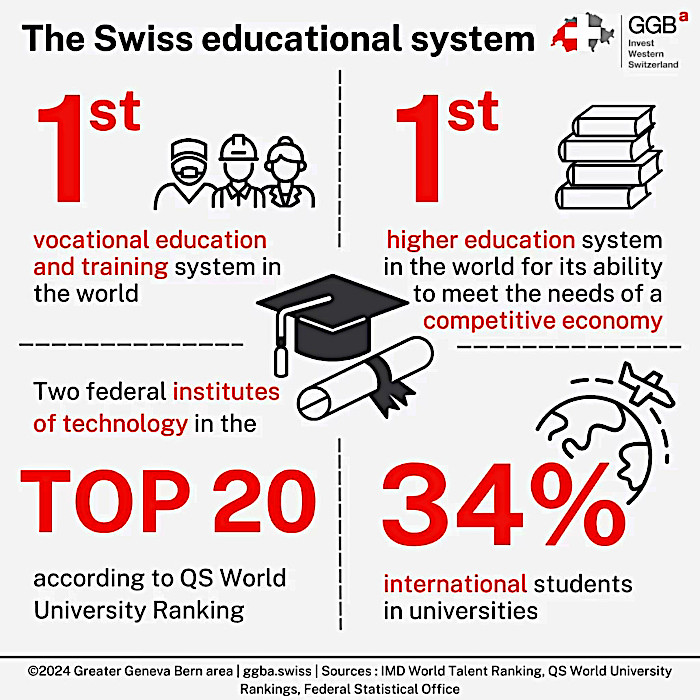
Strong emphasis is placed on vocational training - recognizing the value of practical, hands-on training alongside theoretical knowledge. Vocational pathways are considered prestigious, and they play a crucial role in preparing students for the workforce across 230 trade and professional fields from finance, technology, engineering, business, hospitality, and healthcare.
This vocational training system combines academic learning with practical experience and produces highly skilled and adaptable professionals. This system is a key factor in Switzerland’s top rankings in education and innovation, and in its very low rate of youth unemployment (around 2,5%).
Close collaboration between educational institutes and industries/the private sector - companies play a critical role by providing apprenticeship places, mentors, and real-world work experience, while schools focus on delivering the necessary academic foundation - this ensures the curriculum remains relevant to industry needs and that students are well-prepared for the current and future job market.
Multilingual Education - students typically learn multiple languages during their schooling to prepare them for work in an international world.
Continuous Assessment - is valued rather than relying solely on final exams; teachers use a variety of assessment methods to gauge students’ progress over time which provides a more comprehensive understanding of a student’s abilities and encourages a focus on understanding rather than rote memorization.
Strong Focus on Quality - Rigorous standards are maintained, and there is a commitment to ensuring that students receive a high-quality education regardless of the canton in which they reside. This commitment is reflected in many international assessments where Swiss students consistently perform well.
Tertiary Education and Research - the country invests huge amounts in research and development; tertiary education is often research-oriented and emphasizes critical thinking and innovation. The ETH University in Zürich is consistently ranked as the top university in Europe.

Diagram showing the Swiss education system from Kindergarten to PhD level
The Swiss School system
The State Secretariat for Education, Research, and Innovation (SERI) is the federal body that oversees overall standards of education in Switzerland but each of the 26 cantons has responsibility for the curriculum and administration of schools and training colleges in their cantons. Each canton has its own education department, school calendar, education structure, methods of teaching, and curricula, but with close coordination between all the cantons.
Most Swiss children begin their education around the age of 4 when they enter Kindergarten for 2 or 3 years and move on to Grade 1 only when they are considered 'school-ready'. Formal education is compulsory and free for 9-11 years depending on canton. After this, students can decide whether they want to continue their schooling in an academic direction or follow the vocational training path.
Primary school pupils are allocated to the school nearest to their homes by the local education authorities. If you don't like the school, you have to move to a different area. The choice of academic high school is influenced by its specialisation: eg. maths & science, or languages.
There is no tradition of school ranking as is common in the English-speaking world. There is actually strong opposition from many in the education field, arguing that there are far too many factors influencing academic success or failure. Since a framework of basic high standards that are expected to be met by every school at every stage in a child's school career is set by the State Secretariat for Education, and parents have a direct say in the local schools to ensure that those standards are met, the need for competitive rankings becomes irrelevant.
Public primary schools in Switzerland (from age 6-7 for 6 years) - Depending on the canton, primary school lasts between 4 and 6 years; the language of instruction is that of the region (German, French, Italian, or Romansh). Subjects include the first language, a second national language, English, mathematics, natural sciences, social sciences, geography, history, music, art, physical education, and health. Schools are secular as religion is considered a private matter, and sport is a matter for local sports clubs to organise at the weekends.

Secondary schools in Switzerland (from age 12-13 for 3 years)
Secondary schools in Switzerland are split into the compulsory lower, and two upper secondary options.
Compulsory lower secondary education (equivalent to middle school) - curriculum usually includes the local canton language, a second national language, an optional third language, English, mathematics, the sciences, geography, history, civic education, music, art, physical education.
After completion of the obligatory lower secondary level, the Student + Parent + Teacher must agree together on the next secondary level - either academic high school or vocational training.
Upper secondary education - can be either academic in focus preparing students for university, or vocational preparing students to enter the workforce.
Although the cantons are responsible for their own upper secondary school organization and curricula, cantonal qualifications are valid across Switzerland.
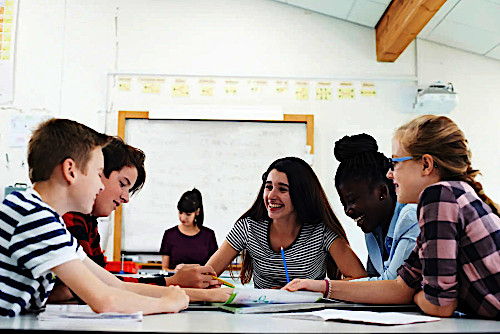
Academic high school leading to university - about 20% of students continue to academic high school for 4 to 5 years leading to the Matura (Maturity Certificate or federal high school graduate diploma) normally attained after 12-13 years of schooling, usually at the age of 19. The Matura grants access to all Swiss universities provided a minimum grade is attained.
The Matura program consists of core subjects (first national language, second national language, third language - usually English - mathematics, biology, chemistry, physics, history, geography), a main specialization (music, IT visual arts, etc), a secondary specialization, and a self-study written thesis on a chosen subject. Students also take introductory courses in philosophy, economics and law.
Vocational education and training schools (the dual-track system)
More than 70% of students, after completing their compulsory lower secondary education, enter vocational training or the 'dual-track' system. Training in over 230 trades and professions can be completed in this system.
Basic training is 3-4 years split between paid employment at a private business offering an apprenticeship with mentor, and training colleges offering appropriate theoretical training; the end qualification is the EFZ = Federal Certificate of Competence.
Those who wish to study further may complete bridging courses to obtain the Berufsmatura (professional Maturity certificate) which gives them access to the Universities of Applied Sciences; these universities offer higher diploma and degree courses up to Masters level.
About 10% of students, after completing the compulsory lower secondary schooling, choose to continue to study full time at a vocational training college doing regular internships at appropriate work-related companies to gain the necessary practical experience.

Homeschooling in Switzerland - is not common in the country, is not encouraged, and in many cantons is not allowed except in very exceptional circumstances.
International schools - Switzerland has 103 private 'international schools' including the most expensive private school in the world (Lyceum Alpinum Zuoz - fees are $200,000+ per year). These schools operate in the private sector offering educational programs for the children of mainly foreign elites and the super-wealthy who live in their own elite world.

Switzerland was the birthplace of the International Baccalaureate in 1968. Some 50 of the international schools offer one or more of the IB programmes to allow children of expat workers to follow a standard curriculum regardless of where they may be living in the world. The IB certificate does not give automatic admission to Swiss universities and a bridging year is often required.


