

Historical origins
Starting in the 15th century, small seams of gold were discovered in the Swiss Alpine regions. Small-scale mining took place until the gold was mined out and the last Swiss gold mine closed for good in 1961.
Yet today, most of the gold in the world passes through Switzerland. Gold arrives here in unrefined form, and leaves the country in all its glittering purity. It is a business worth around CHF 90 billion.
Five of the largest gold refineries in the world are found in Switzerland, three are in Mendrisio (Canton Ticino). Together they process 70% of the unrefined gold mined in the world each year.
Products produced in the Swiss refineries include a range of investment grade precious metals bars, precious metals coins, alloys and high precision products for the electronics, chemical, watch and jewellery industries.
So how did Switzerland manage to develop into a top-level platform for the gold trade - without any natural resources of its own?
Apart from tradition - Zürich was always an important gold trading centre-- other factors making Switzerland an attractive venue for gold refining include:
- continuous political stability
- efficiency in financial services and proximity to leading financial centers
- high level of education
- strict regulations in the industry
- high-quality infrastructure
- moderate taxes, and
- Swiss precision.
Value to the Swiss economy
The gold refining sector is a key "jewel in the crown" for the Swiss economy.
2017 Imports - 2'404 metric tons of gold imported, value approx CHF 70 billion = 31% of imports directly linked to gold.
2017 Exports - Switzerland exported gold worth approx CHF 67 billion = 24% of exports directly linked to gold.
Only the pharmaceutical industry exports more: in 2017 Swiss pharma companies exported goods to the value of CHF 98 billion.
Five of the world's largest gold and precious metal refineries are located in Switzerland
Argor-Heraeus SA

established in 1951 in Mendrisio (Canton Ticino) - annual gold refining capacity of approx 350 - 400 tonnes; processes and refines gold up to 99.999% purity, also silver, platinum and palladium; transforms 'good delivery' bars into smaller bars; to combat gold bar counterfeiting it developed 'kinebars' using unique holographic technology.
MKS Pamp (Produits Artistiques Métaux Précieux)
established in 1977 in Mendrisio - began as a minting facility for small bars and an alloy specialist for the jewelry and watchmaking industry; now also offers services from mining to bullion production, producing bars from 1 gram to 12.4 kilograms, and custom minting for private companies and government mints.
Valcambi
originally established in 1961 as Valori & Cambi by a group of Swiss businessmen from Mendrisio. Taken over by Credit Suisse bank in 1980; since 2015 it has been wholly owned by the Indian conglomerate, Rajesh Exports Limited.
Cendres + Métaux

established in 1885 in Biel - manufactures high-precision precious metal parts for the watch and jewelry industry, and supplies the industry with semi-finished precious metal products.
Metalor Technologies

current headquarters are in Neuchatel but it was originally established in 1852 in the watch-making town of Le Locle as Métaux Précieux SA, specializing in smelting gold and manufacturing watch cases. It has become a major supplier of precious metals and alloys for the worldwide watch and jewellery industry. 1982 it opened a refinery in Hong Kong, in the US in 1986, and Singapore in 2014. In 2016 it was bought by the Japanese precious metals producers Tanaka Kikinzoku.
Short history of gold refining in Switzerland
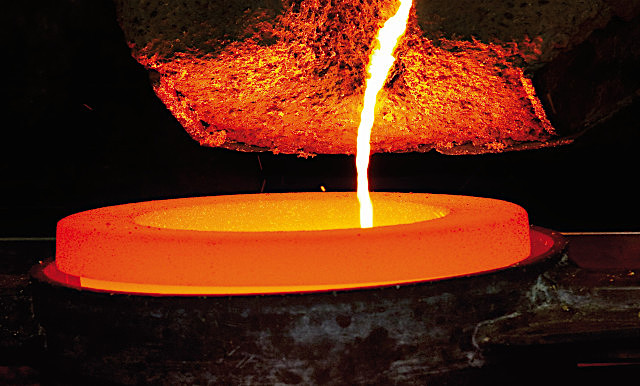
The 17th century influx of Protestant refugees from France into Switzerland brought watch-making skills leading to the development of the watch industry in the country, particulary in the western region. The growing watch-making industry processed gold themselves to ensure quality standards, and the financial centers provided the decisive financial impetus for Switzerland to become a melting pot for the gold industry.
After the Second World War, the big banks bought their own refineries and drove the business forward. Switzerland's banks had stored considerable amounts of war gold which gave them a starting advantage.
In recent years central banks have been increasing their gold reserves. Emerging countries such as Turkey and China in particular are currently stocking up on tons of the precious metal.
This benefits the Swiss gold refineries as the central banks prefer standard bars of 400 troy-ounces (12,4 kgs). These bars first have to be cast which is where the Swiss smelters that specialise in 400 troy-ounce bars come in.
In 2025 the unpredictable actions of US President Trump has caused an investor rush to the safe haven of gold, especially in the USA, with tons of gold being moved from safe storage in the vaults of the Bank of England in London to New York.
This in turn ensures that the Swiss gold refineries are working at full capacity thanks to a quirk in the global bullion markets of London and New York using different size bars:
- In London, gold trading is in 400-troy-ounce bars, roughly the size of a brick.

- in New York, the Comex exchange uses smartphone-sized 1kg bars as its benchmark.

So gold bars being exported from London to New York must first make a stop in Switzerland to be melted down and re-cast into 1 kg bars!