
Early history to Roman colony
Archaeological evidence of prehistoric settlements, especially at the lake shores, has been discovered in Switzerland.
200-100 BCE - Celtic tribes, the Rhaetians and the Helvetii, migrated south from Germany at the same time that Roman legions were moving north. The Romans defeated the Helvetians in 58 BCE and established the province of Helvetia with their capital city at Aventicum (today's Avenches)
Regions populated by Celtic people progressively assimilated into Roman society. Peace and prosperity reigned. The first mountain passes - Julier, Splügen and Oberalp passes - were opened.

3rd-6th centuries - There were great migrations of people in Europe - the Germanic Alamannen settled in northern Switzerland while the Burgundians settled in western (French-speaking) Switzerland; in Graubünden the Rhaetian-Romans strongly resist any incursions so managed to retain their territory and autonomy.
The 4 languages of Switzerland come into existence around this time - Alemannic-German in the North and East, Latin-based French dialect of the Burgundians in the west, Latin-based Italian in the south while the more isolated Rhaeto-Romans kept their Rhaeto-Romanic language.
Many regions start converting to Christianity.
The Middle Ages to Old Swiss Confederacy
Powerful family dynasties arose. The Habsburgs grabbed power over the regions that would one day become Switzerland.
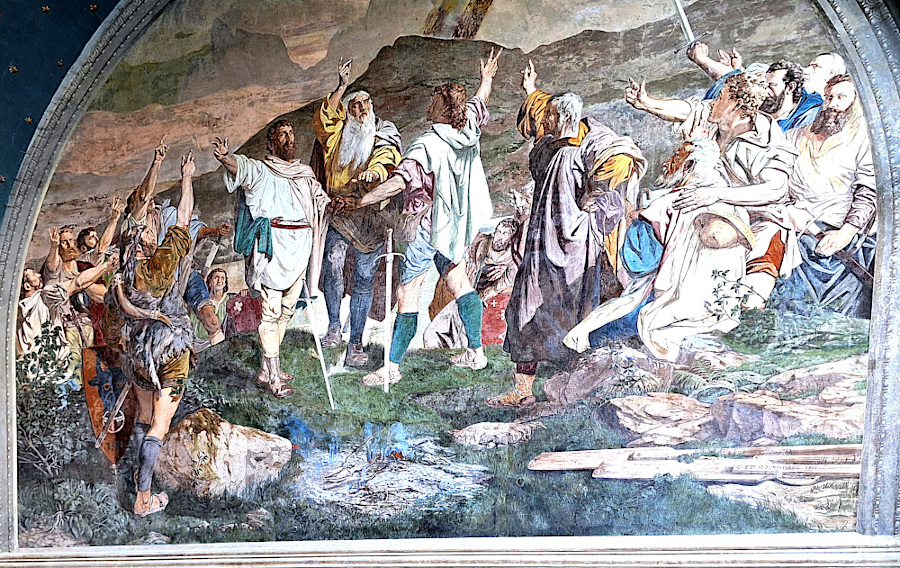
1291 When the Habsburg ruler, Rudolph 1 died and left a power vacuum, the central regions grabbed the opportunity to enter into a permanent alliance to support each other and become independent; the cantons of Schwyz, Unterwalden and Uri formed the old Swiss Confederation - late 19th century politicians proclaimed this as "the birth of modern Switzerland".

14th century The Confederation continued to grow through alliances with more cantons and the cities of Lucerne, Zurich and Bern joining it. By 1513 it became the "Confederation of Thirteen (Cantons)".
1515-1516: Military expansion by the Swiss Confederation ended with its defeat at the battle of Marignano. From then on, the Swiss cantons would remain neutral and only supply mercenaries to the various warring European powers.

16th century - the Protestant Reformation
Switzerland was rocked by the Reformation. Urban regions embraced Protestantism but the poor, rural areas remained faithful to the Catholic Church dividing the Confederation into Catholic and Protestant blocks. Conflicts and armed clashes continued well into the 19th century. The leading figures in the Swiss Reformation were Ulrich Zwingli (1484-1531) in Zurich and Jean Calvin (1509-1564) in Geneva.

Portrait of Ulrich Zwingli
17th century - Neutrality
A period of prosperity for Switzerland. It stayed neutral in Europe's Thirty Years War (1618-1648) and in the peace agreement, Treaty of Westphalia, it was granted independence from the Holy Roman Empire and formal recognition as a separate independent state. It adopted a policy of neutrality while at the same time concluding contracts with many European states for the supply of mercenaries.
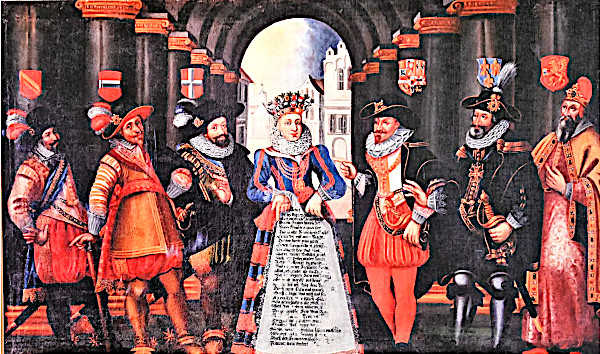
Helvetia wearing a crown of cantonal flags surrounded by kings and dukes bidding for her mercenaries
18th century Economic growth in Switzerland continued, boosted by the arrival of Protestant Huguenots fleeing religious persecution in France.
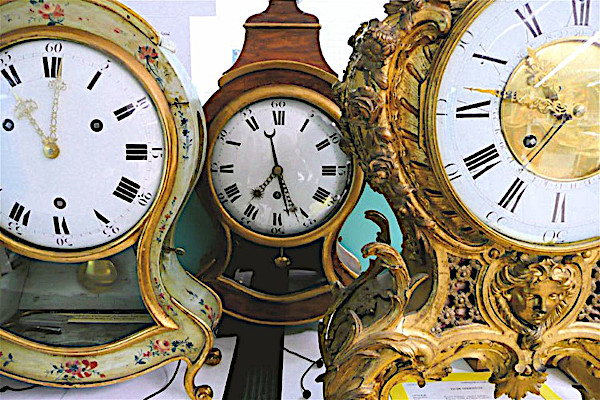
Besides agricultural products and mercenaries, cottage industries in textiles, and watch-making become increasingly important for the export sector making Switzerland the most industrialised country in Europe at that time.
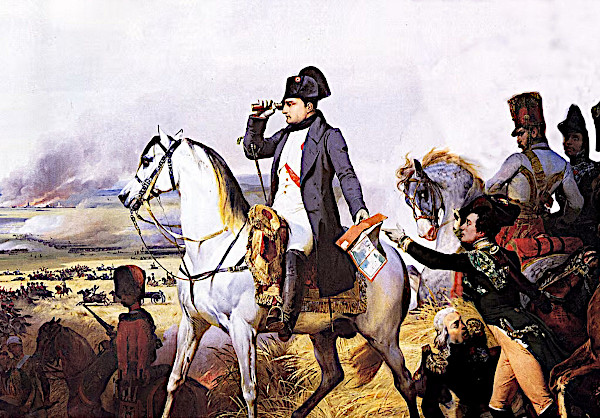
Napoleon invades Switzerland - Helvetic Republic
1798 French troops invaded Switzerland and created the Helvetic Republic,a centralised unitary state governed by representative democracy - quite the opposite to the Swiss way of government. Conflict ensued until Napoleon's Mediation Constitution of 1803 restored the independence of the cantons and added six new cantons.
At the Congress of Vienna of 1815 that ended the Napoleonic era, Switzerland gained another three cantons. The European Great Powers also formally recognised Switzerland's national borders and its perpetual neutrality. The Federal Treaty of 1815 brought together the various federal alliances into a single confederation of states with the country's borders as they are today.
19th century : political conflicts over cantonal rule vs federalism
Diverging views on how the Confederation should be organised led to a civil war between liberal supporters of increased federalism and Catholic conservative forces aiming to defend the sovereignty of the individual cantons. The liberal forces emerged victorious.
In 1848 a federal state with a Federal Constitution, based on the USA model, was created; Bern became the de facto capital of Switzerland. The Federal Constitution provided male citizens with various rights and freedoms.
The Swiss franc became the standard currency; weights and measures were standarised, but the cantons retained a high degree of independence.

Helvetia, enthroned in the centre, is crowned with a laurel wreath as she holds the new Federal Constitution. She is flanked on both sides by citizens depicted in military uniform and in civilian dress, embodying the people as the supreme political authority.
19th to 20th century: rapid railroad construction leads to a boom in industrialisation
A dense railroad network rapidly develops from 1847 onwards promoting mobility and industrialization leading to an economic boom; the chemicals industry and precision engineering were particularly developed.
The growing tourism industry further drove more railway construction, often with foreign (mainly British) investment finance. Hotels and tourist attractions were rapidly built in previously neglected alpine settlements leading to a tourism boom that was largely killed by the First World War.
Early 20th century: First World War - Proportional representation
Switzerland remained neutral in WW1 but was economically ill-prepared for the long war. Poverty, hunger and unemployment increased making fertile ground for socialist ideas influenced by the Russian Revolution and culminating in a General Strike in 1918.
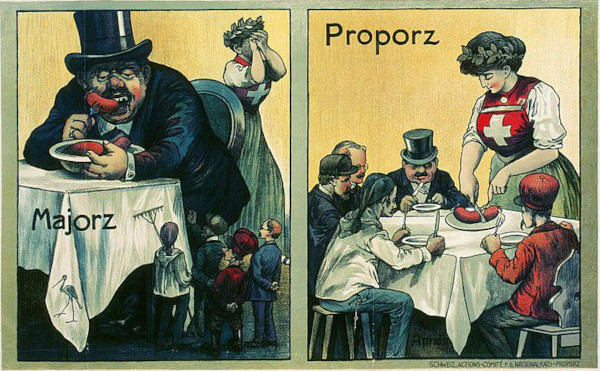
1919 - a referendum to elect the National Council in proportion to the share of votes and not according to the majority (winner take all) principle was voted in; the Liberals lost their majority, while the Socialist Party and the Farmers' Party gained influence as a result.
1939-1945 Second World War
With another World War looming, the political forces from the far left to the far right moved closer together to form a unified front.
Henri Guisan, voted in as General of the Swiss Military, started to implement the strategy of preparing for a retreat to a “Réduit” (Redoubt) in the Alps in the case of an invasion. By 1942 Switzerland was completely encircled by Germany, Italy and German-occupied France. Food rationing helped to prevent starvation. With a lot of difficulty Switzerland managed to maintain its neutrality and emerged from the hostilities largely unscathed.

Post-war boom phase
Switzerland experienced a long phase of strong economic growth after the war, with rising living standards and improved social security. Its tradition in machine building, chemical and pharmaceutical processes and financial services enabled it to establish itself as an important player on global markets.
Political stability built from a perpetual coalition of four parties from leftwing to rightwing, as well as improved government programs for social security and a negotiated partnership between employers and trade unions increased productivity and prosperity for all.
Women finally get the vote
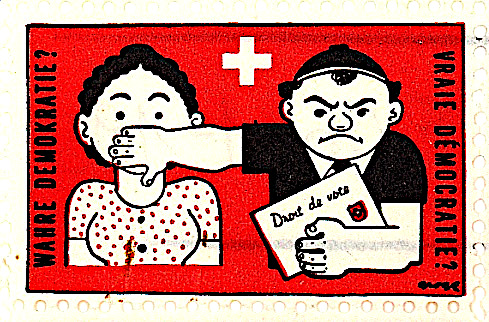
In February 1971, 66% of the electorate, then exclusively male, finally voted in favour of the women's franchise at federal level. Previously from the 1950s onwards women could only take part in politics at community and cantonal level (depending on canton, sometimes not at all!).
21st century: Switzerland joins the UN and Schengen Agreement
Switzerland finally joined the United Nations in 2002, and the voters approved numerous bilateral agreements with the European Union. But Swiss voters rejected further integration steps towards the EU and today Switzerland joining the EU is considered an absolute No-Go.
Swiss voters agreed to the Schengen Treaty on free movement of people within Europe - at first regarded as a benefit, but now seen more as a negative for Switzerland since far too many Europeans come to live and work in Switzerland driving housing prices ever higher and causing much dissatisfaction in the local population.
The opening of major tunnels through the Alps - the Lötschberg 2007 and Gotthard Base Tunnel 2016 - makes Switzerland even more a critical transit country for passengers and freight between Northern and Southern Europe.
Long understanding of geopolitical reality and investing in human resources has enabled Switzerland to retain its key neutral position in the heart of Europe - a little country that punches above its weight class.
