Basic info for the day
- Morning - depart on the Luzern-Interlaken Express on a scenic journey past 4 lakes in the Central Swiss region before climbing up and over the Brünig Pass and into the Bernese Oberland.
- On the descent from the Brunig Pass, we stop in the town of Brienz to board a classic lake steamer on a short boat ride to Giessbach, famous for its historic hotel and spectacular waterfall. The ride up to the hotel is via a historic funicular, Europe's oldest mountain cable railway opened in 1879.
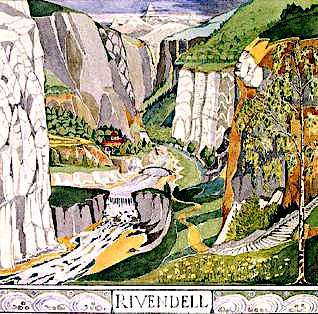
- Afternoon - continue on an hour's cruise across Lake Brienz to Interlaken; time to explore this famous town that brought mass tourism to Switzerland. Finally take the train up the Lauterbrunnen Valley, the inspiration for Tolkien's Rivendell, to end the day at Lauterbrunnen.
- Dinner at the hotel.
Giessbach Falls

The Giessbach Falls tumble down the mountainside in 14 tiers, plunging 500 m (1,600 ft) in thunderous cascades down to Lake Brienz - a natural feature that became an extremely popular tourist attraction during the early 19th century.
The falls are best seen on a walking trail that crosses over the falls in two places and even behind allowing one to feel the power of the rushing water.
The Grand Hotel Giessbach opened in 1875, one of 3 hotels originally at the Falls and the only one to survive the wreckers ball of the 1970s thanks to a concerted national crowd-funding effort to save it. Today it is run by a foundation dedicated to the preservation of the history of a bygone era that brought tourism to Switzerland.
The Giessbach Funicular was constructed in 1879 (145 years ago) to bring guests up to the hotels. The funicular is Europe's oldest cable railway and was honored in 2015 by being included in the list of Historic Mechanical Engineering Landmarks by the American Society of Mechanical Engineers.
Interlaken

Population: approx 15,000 inhabitants
Name means “between the lakes” - it lies spread over the flood plain between Lake Brienz and Lake Thun with the Aare River linking the 2 of them - a strategic transport node.
Previously known as Aaremühle (Mill on the Aare) but this was considered too much of a tongue-twister for the wealthy 19th century English tourists so not good for marketing - Interlaken sounds much more romantic and the city authorities were mindful of the economic benefits of tourism.
Thanks to its proximity to the Jungfrau massif, it is one of oldest and most well-known summer resorts - in 1870 it had 73 hotels (today it has 31 hotels).
History - 1133 Augustinian monastery established “inter lacus”; in time the monks became the largest landowners in the area.
1528 the monastery was “nationalised” after the Protestant Reformation since Canton Bern was an early convert to Protestantism. What remains of the old buildings is now city council admin offices.
Until it was taken over by tourism, it was a desperately poor valley and many citizens emigrated to the USA to escape hunger and hopelessness.
Tourism saves it - From early 18th century onwards tourism became increasingly important. The 19th Century Romantic poets redefined mountains as something more than cold, troublesome obstacles - they encouraged people to flock to the Alps “because they are there”.
Grand hotels were built to accommodate wealthy travellers from smog-ridden big cities. They were attracted to Interlaken because it was close to the Alps but without the hardship of getting there.
The grandest hotel, the Victoria-Jungfrau was (and still is) the epitome of luxury - hundreds of bedrooms, ballrooms, reading rooms, servants. It got electric lighting 8 years before the town streets; 1st elevator in town; largest telephone switchboard in the whole country.
In the late 19th century tourists stayed for weeks at a time during “the Season”. The local newspaper carried details of who had arrived in town, and there were 2 church services per day in English.
Military High Command - during WW2 the bunkers in the surrounding mountains became the headquarters of the Swiss Military High Command.
Interlaken today is all about location - the town has become a springboard for high altitude thrills and shopping for watches; Interlaken Ost station is the central railway changing point from wide-gauge to narrow-gauge trains.
Lauterbrunnen
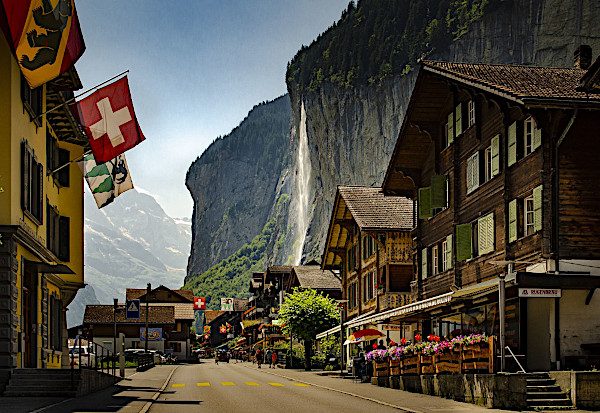
lies at the bottom of a U-shaped valley between imposing rock faces and mountain peaks and because of its stunning setting has become a tourist hotspot.
Population: 2'500 year-round residents, swelling in the tourist season to thousands more.
History: first mentioned in 1240 when it came under the ownership of the Interlaken Monastery. After the 16th century Protestant Reformation, the monastery was dissolved and its lands and properties, including the Lauterbrunnen valley, were seized by the Canton of Bern.
In the 17th and 18th centuries the poverty was so widespread that many of the villagers joined mercenary regiments or emigrated to the Carolinas in the USA.
From the late 18th century, foreign mountain climbers began to use Lauterbrunnen as a starting point for Alpine expeditions. Lauterbrunnen's fame as a base for alpinists grew, bringing finance for the building of tourist infrastructure - hotels, the road from Interlaken in 1834, the railway in 1890, cable cars to Mürren in 1891, and railway to Wengen in 1893.
Year-round tourist centre: in 1909 Englishman Arnold Lunn popularized skiing, curling and bobsledding at Lauterbrunnen bringing a whole new group of winter tourists and converting the summer tourist industry into a year-round business.
The tourist economy of Lauterbrunnen was devastated by World War I and II and the Great Depression. At the end of World War II tourism rebounded with investment in new tourist infrastructure.
The Lauterbrunnen Valley is one of the deepest in the Alpine chain when compared with the height of the mountains that rise directly on either side. It is a true cleft between limestone precipices, sometimes perpendicular; in places the cliff walls are up to 1,000m (3,300ft) high.
Valley of waterfalls - 72 waterfalls tumble over the cliff edge forming cascades so high that they are almost lost in spray before they reach the level of the valley. The most famous of these waterfalls is the 297m (974ft) high free-falling Staubbach Falls visible from Lauterbrunnen village.
Base-jumping paradise - the valley is a prime location for wingsuit base-jumping with 13 legal jump points recording approx 20,000 jumps annually, of which on average 3 end in fatal disaster. In 2021 the parish of Lauterbrunnen unveiled a memorial in its cemetery, dedicated to base jumpers and mountaineers who lost their lives in the pursuit of adventure in the valley.
Inspiration for Rivendell - J. R. R. Tolkien hiked from Interlaken to the Lauterbrunnen Valley while on holiday in 1911. The landscape of the valley later provided the concept and pictorial model for his sketches and watercolours of the fictitious valley of Rivendell