
Basic info for the day
- Morning - boat ride on Lago Maggiore, the large lake shared between Switzerland and Italy. From Locarno at the northern end of the lake, take a cruise to the beautiful Brissago Islands, since 1950 a public island botanical garden.
- Disembark for a 2 hour exploration of the botanical gardens and enjoy refreshments at the restaurant before catching the boat back to Ascona. You have time to walk around this jewel village and enjoy lunch before returning to Locarno by local bus.
- Afternoon - take the funicular up to the imposing Church of Madonna del Sasso from where we continue by cable car to Cardada and finally by 2-person chairlift to the summit of Cimetta for the most stunning views over the lake and surrounding mountains, so ascending from 200 to nearly 2000 m.
- Group dinner at a local restaurant.
Lago Maggiore
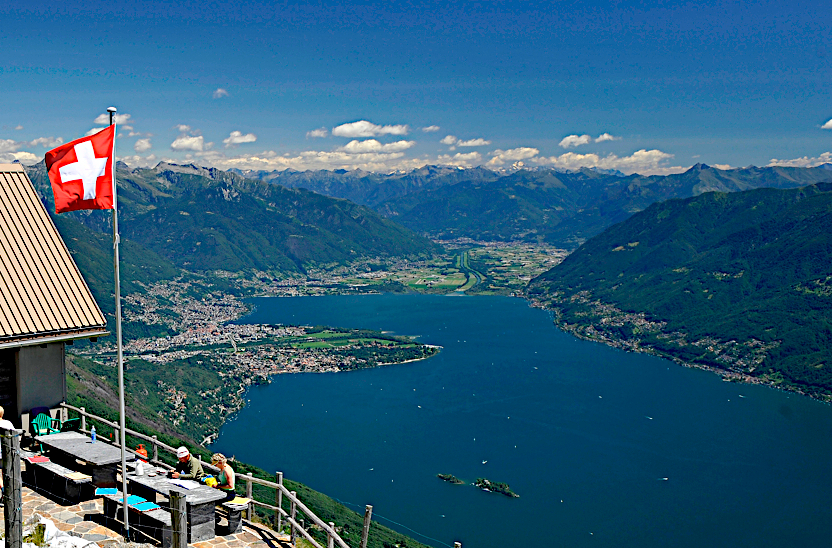
Lago Maggiore is a 64 km (40 mi) long, thin and sinuous lake extending from the Italian-speaking part of Switzerland into the Italian regions of Piedmont and Lombardy. The northern 13 kms (8 mi) lie in Switzerland. The lake was formed through tectonic-glacial action. Thanks to its mild climate, there is lush, Mediterranean vegetation along its shores.
The Ticino river, a main tributary of the Po River, drains into the lake, as well as the Maggia river, which form a wide low-lying delta at the northern end.
From 1827 when the Lombardo-Sardo-Ticinese company put into service a fleet of lake steamers, the lake-going service became a fastest means of transporting goods and people over-taking the much slower road transportation. It also quickly took over the postal service, not just for transporting mail, but also for on-board postmarking.
Today it is a prime tourist attraction bringing thousands of tourists to the picturesque villages along its shoreline.
Key statistics:
- 2nd largest lake in Italy; 1/5th falls in Swiss territory
- Total area is 212.5 km2 (82 sq mi)
- Length is 64 km (40 mi)
- Average width is 3-5 km (2-3 mi)
- Elevation is 193 m (633 ft) above sea level
- Depth at its deepest point is 372 m (1'220 ft)
- Volume is 37.7 km3 (9 cu mi)
Brissago Islands Botanical Gardens
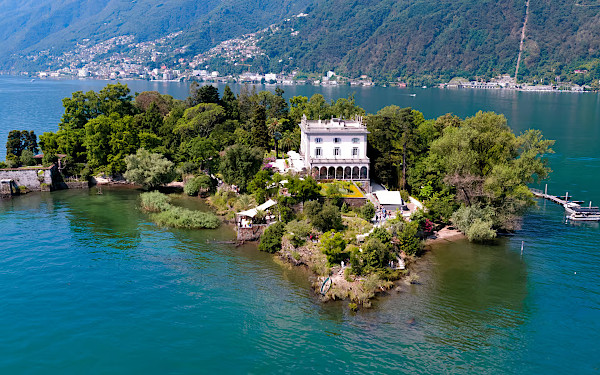
The two little Brissago islands lie approx 1 km offshore in Lake Maggiore. The smaller island is uninhabited and vegetation is allowed to grow naturally, but on the larger island is a botanical park with over 2,000 plant species from the world's main 'Mediterranean climatic zones' - the Mediterranean basin itself, Chile, South Africa, Australia and California - as well as plants from other areas with a humid subtropical climate.
The waters of Lake Maggiore accumulate heat during the summer and give it back during the winter giving the Brissago Islands a climate that is completely subtropical. This makes it the ideal place to grow plant species not normally found in Switzerland
Although inhabited since Roman times and used as a refuge by early Christians who built a monastery on the islands, they eventually were abandoned until 1885, when the exotic Russian-born Baroness Antoinette de Saint Léger and her husband bought them and made their home there. They transformed the big island into a botanical park, importing plants (and boat-loads of soil) from all over the world. In 1926 the Baroness ran into serious financial difficulties and sold the islands to German department store magnate Max Emden who built the Villa Emden.
In 1949 the islands were bought by the Canton Tessin and the Swiss Heritage Society and opened to the public.
Ascona
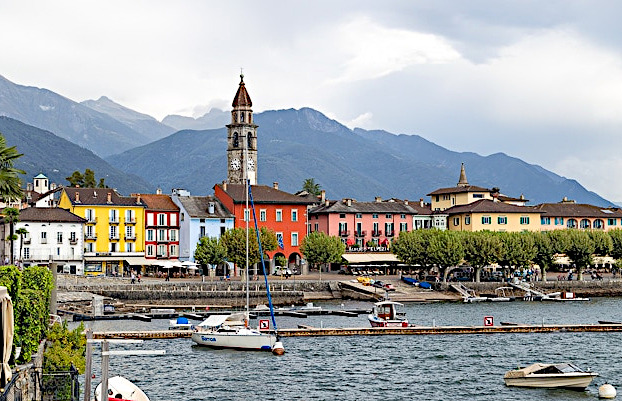
Ascona has the distinction of having the lowest elevation in Switzerland at 196 m (640 ft) above sea level.
It was a quiet little fishing village and well-kept secret for many years. In the early 20th century a group of naturists established a colony on the Monte Verità hill above the town. It became a cultural and spiritual centre which attracted Europe's leading revolutionaries, New Age philosophers, writers and artists which in turn sparked the development of tourism.
The town has a picturesque tree-lined lakeside promenade with colorful buildings, cafés, and restaurants. The old town, the “Borgo”, has narrow, cobbled streets and alleys with trendy art galleries and boutiques. Its major landmark is the belltower of the Church of Saint Peter & Paul located in the center of the old town.
Ascona is also known for its annual Jazz Festival "JazzAscona" - the only festival in Europe officially supported by the City of New Orleans. Over 10 days in early July around 200 free concerts are offered in bars and restaurants, on the lakeshore and in the town squares; music genres include everything from New Orleans jazz to swing, blues, R&B, gospel and soul, and a mixture of them all.
