
Basic info for the day
Morning - depart on the Luzern-Interlaken Express on a scenic journey past 4 lakes in the Central Swiss region before climbing up and over the Brünig Pass and and alongside the turquoise waters of Lake Brienz to the famous resort town of Interlaken.
In Interlaken, Take a walk through the town to the Interlaken West station where we board the GoldenPass Express with its unique railway gauge-changing technology.
Afternoon - travel through picture-postcard beautiful valleys and scenic pre-alp villages before arriving in Montreux on the Eastern shores of Lake Geneva, in Switzerland's French-speaking region, and home to the wonderful Marché de Noel Christmas market.
Dinner at the hotel
Key info on Interlaken

Population: approx 15,000 inhabitants
Name means “between the lakes” - it lies spread over the flood plain between Lake Brienz and Lake Thun with the Aare River linking the 2 of them - a strategic transport node.
Previously known as Aaremühle (Mill on the Aare) but this was considered too much of a tongue-twister for wealthy 19th century English tourists so not good for marketing - Interlaken sounds much more romantic.
Thanks to its proximity to the Jungfrau massif, it is one of oldest and most well-known summer resorts - in 1870 it had 73 hotels (today it has 31 hotels).
History - 1133 Augustinian monastery established “inter lacus”; in time the monks became the largest landowners in the area.
1528 the monastery was “nationalised” after the Protestant Reformation; what remains of the old buildings is now city council admin offices.
Until it was taken over by tourism, it was a desperately poor valley and many citizens emigrated to the USA to escape hunger and hopelessness.
Tourism saves it - From early 18th century onwards tourism became increasingly important. The 19th Century Romantic poets redefined mountains as something more than cold, troublesome obstacles – they encouraged people to flock to the Alps “because they are there”.
Grand hotels were built to accommodate wealthy travellers from smog-ridden big cities. They were attracted to Interlaken because it was close to the Alps but without the hardship of getting there.
The grandest hotel, the Victoria-Jungfrau was (and still is) the epitome of luxury - hundreds of bedrooms, ballrooms, reading rooms, servants. It got electric lighting 8 years before the town streets; 1st elevator in town; largest telephone switchboard in the whole country.
In the late 19th century tourists stayed for weeks at a time during “the Season”. The local newspaper carried details of who had arrived in town, and there were 2 church services per day in English.
Military High Command - during WW2 the bunkers in the surrounding mountains became the headquarters of the Swiss Military High Command.
Interlaken today is all about location - the town has become a springboard for high altitude thrills and shopping for watches; Interlaken Ost station is the central railway changing point from wide-gauge to narrow-gauge trains.
GoldenPass Express

The GoldenPass is the latest in the list of panoramic train journeys through Switzerland, in operation in this form since Dec 2022. The train runs from Interlaken all the way to Montreux in 3 hrs 15 mins, and finally links the Bernese Alps region to Lake Geneva without the need to change trains.
The idea to link the 19th century tourist hotspots of Interlaken and Lakes Thun and Brienz with Lake Geneva was first proposed in 1873, but differences in railway gauges and electricity systems prevented this from happening.
140 years later, using cutting-edge variable gauge technology, the new direct train overcomes the challenges of 2 different track gauges (standard and narrow gauge) in height and width, and variances in voltage requirements. Where previously travellers had to change trains at Zweisimmen, now they remain seated in the train as it slows down to 15 km/h and the wheelbase expands or contracts to fit the new gauge as the train passes over the gauge-changing mechanism.
The complex trucks beneath each carriage can also raise the body height to meet the higher platforms of the stations along the standard gauge line, or vice versa along the narrow gauge route, so elevating or lowering the coach from 350mm to 550mm in a few seconds, making this a world-first feature.
Key info on MONTREUX
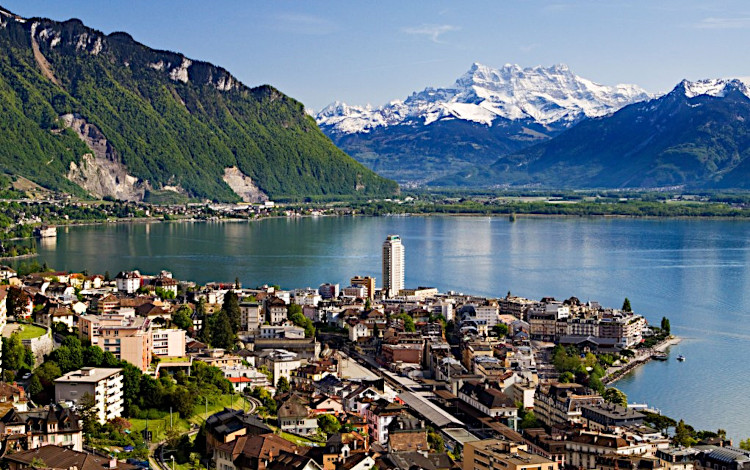
Location - eastern shore of Lake Geneva in view of the French Alps across the lake.
Capital of the "Swiss Riviera"
Population - 26,000; 44% of residents are foreigners
Climate - exceptionally mild; plants associated with the Mediterranean and tropics (like cypresses and palm trees) grow well here.
Belle Epoque - city gained fame as a resort in 18-19th centuries - many old "belle époque" style hotels and buildings in French style
Centre for private education - 4 private international boarding schools and 3 private hotel schools located in or close to the city
Jazz Festival - since 1967 hosts the annual Montreux Jazz Festival at beginning of July; has since expanded to include pop and rock music.
Notable residents past and present - Charlie Chaplin, James Mason, Ernest Hemingway, Noel Coward, Zelda Fitzgerald, Graham Greene, Vladimir Nobokov, Igor Stravinsky, Tchaikovsky, David Bowie, Freddie Mercury, Shania Twain