

Born in 4th C (during Roman times) into a wealthy Greek-Christian family in modern day Turkey.
He was known for distributing his wealth to the poor through secretly giving gifts -- gave rise to the traditional model of Santa Claus (name comes from the Dutch Sinterklaas and taken to New Amsterdam colony that later became part of the USA).
There are no known contemporary written accounts of St Nicholas but by the 6th C, he had become a cult figure with many stories of his good works.
He became the most popular non-biblical saint in the pre-modern Christian Church and more churches have been named for him than any other saint except Mary, mother of Jesus.

St. Nicholas is Patron Saint
of a vast variety of causes including some very unlikely groups, like thieves and prostitutes—not because he helps them sin, but because he helps them repent and change.
- Sailors & fishermen - all boats on Lake Lucerne are "christened" at the St Nicholas island off Meggenhorn
- Repentant Thieves and the Falsely Accused
- Prostitutes
- Children
- Brewers
- Pawnbrokers
- Students
- the countries of Russia and Greece
- the city of Liverpool
and far too many others to mention ....!

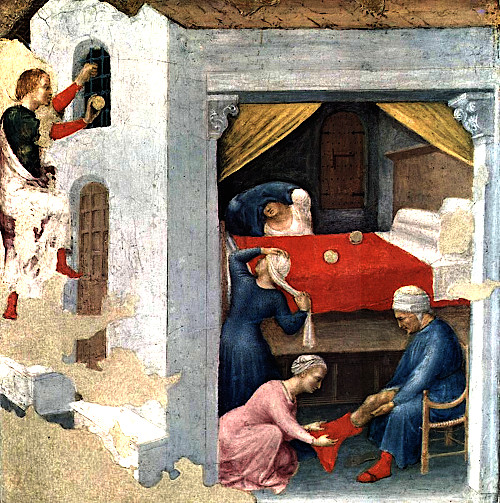
Dowry for 3 poor sisters
According to legend, he saved 3 sisters from a very poor family from being forced into prostitution by secretly dropping a purse of gold coins through their house window at night for 3 nights so their father had enough to pay dowries for all the daughters.
He gave his gifts secretly as he wanted to spare the recipients the humiliation of accepting charity.
Feast Day of St Nicholas : 6th Dec
6th Dec in Western Christian countries (or 19 Dec in Eastern Christian countries according to the old church calendar) was believed to be the day of his death.
It was already an old pagan festival day to chase out the dark winter spirits with noise and festivities. The church incorporated elements of the old pagan festival into a new feast day celebrating St Nicholas --- like today's Küssnacht Klausjagen.
In old days gifts were given to children on this day leaving 24/25th Dec for religious devotion.
Gifts were usually in the form of exotic foods which were expensive and unobtainable in the middle of winter -- goods baked with tasty exotic spices, vitamin-rich oranges and clementines imported from sunnier parts of the world, ground nuts, etc.
Early images show he wore a bishop's mitre and carried a bishop's crozier -- and today, guys who play St Nicholas dress like this on 5th/6th Dec.
During the Protestant Reformation of the 1500s, Catholic saints were banned so Martin Luther proclaimed it was not St Nicholas but the Christ-Child who brought gifts and switched gift giving from 6th Dec to 24/25th Dec.

Companions of Saint Nicholas
St Nicholas is always accompanied throughout Central European countries by companions dressed in black, who act as a foil to the benevolent Christmas gift-bringer, threatening to beat or abduct disobedient children.
Jacob Grimm (Deutsche Mythologie) associated this character with the pre-Christian house spirit which could be benevolent or malicious, but whose mischievous side was always emphasized after Christianization.
The "dark" or threatening companion figures have various names in different countries and in different language dialects:
- Germany = Knecht Ruprecht, Rumpelklas; Bellzebub
- Bavaria & Austria = Krampus
- Slovenia, Croatia, Hungary = Krampusz
- Switzerland = Schmutzli
- Netherlands & Flanders = Zwarte Piet
- France & Wallonia = Père Fouettard

In Switzerland the attendants of St Nicholas are called "Schmutzlis".
St Nicholas becomes Santa Claus ...
The tradition of St Nicholas and gift giving occurs all over Europe, and was taken by the Dutch to its colony of New Amsterdam -- Dutch called him "Sinterklaas" hence Santa Claus.
1920s a popular poem and cartoon depicted Santa as a jolly, corpulent fella with big white beard, and his bishop's mitre morphed into a red hat.
1931 - Coca Cola put out an advert at Xmas time that fixed the image of Santa Claus we all think of today.
Coca-Cola commissioned illustrator Haddon Sundblom to paint Santa for Christmas adverts. Those paintings established Santa as a warm, happy character with human features, rosy cheeks, a white beard, twinkling eyes and laughter lines.
Sundblom drew inspiration from an 1822 poem by Clement Clark Moore called “A Visit from St. Nicholas” —commonly known as “Twas the Night Before Christmas.”
