

Origins of Swiss rail

Although the railway age came late to Switzerland compared to other European countries, its railways have now achieved a high reputation for reliability, punctuality, density of the network, co-ordination between services and integration with other modes of transport like bus, tram and boat.
In the annual European Railway Performance Indexes, Switzerland regularly ranks 1st among national European rail systems in for its intensity of use, quality of service and strong safety rating.
Railways in Switzerland
Key Facts & Figures
Densest rail network in Europe

Switzerland's rail system covers approx 5,200 kms/3,241 miles of railway or approx 315 kms/196 miles of track per 2,590 km2/1,000 sq. miles - over 2½ times the European average. The network supports 153 trains per network kilometer per day.
About 3,000 kms/1,860 miles are owned by the Swiss Federal Railways (SBB), 2,000 kms/1,240 by private railways, and another 200 kms/120 miles consist of mountain railway lines (cogwheel or funicular).
¾ of the Swiss rail network (3,773 km/2,344 mi) is standard gauge tracks (1,435 mm/4'81⁄2”), and ¼ (1440 km/890 mi) is narrow gauge track (1m/3,3 ft)
All-Electric & environmentally friendly

In 1916, the SBB (Swiss Federal Railways) decided to electrify its rail network using the high-tension single-phase alternating current system that is still used on all routes today.
95% of the electricity for the rail network comes from clean hydro-power, making Switzerland's rail network one of the most energy-efficient in the world.
A train journey in Switzerland generates 20 times less CO2 than the equivalent journey by car.
Hybrid technology
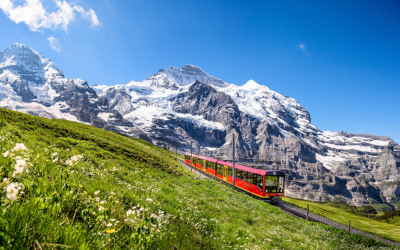
Several of the mountain railways use technology similar to hybrid cars.
They capture and use the energy produced in downhill braking - eg on the Jungfrau Railway, every four trains going down produces enough power to send one up.
Highest rail usage in world

The Swiss Railway Network has the distinction of having the highest rail usage in the world. On average, each person in Switzerland takes 72 rail trips per year covering around 2,463 kms/1,600 miles.
The proportion of commuters using public transport as their main mode of transport is 30%.
The share of goods transported by rail is 39%.
Busiest railway stations
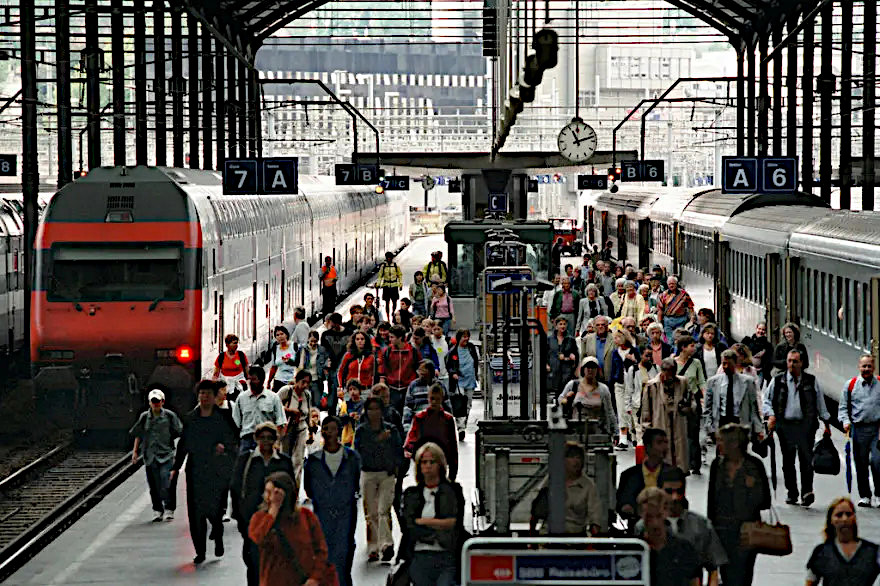
400'000 passengers per day (ppd) pass through Zürich HB (2023) on its daily 3'000 train departures and arrivals.
Station |
People per day |
|---|---|
| Zürich HB | 400'000 |
| Bern | 175'400 |
| Luzern | 99'400 |
| Winterthur | 99'100 |
| Basel SBB | 98'600 |
| Lausanne | 96'700 |
| Zürich Oerlikon | 82'200 |
| Geneva | 79'500 |
World's Longest Rail Tunnels
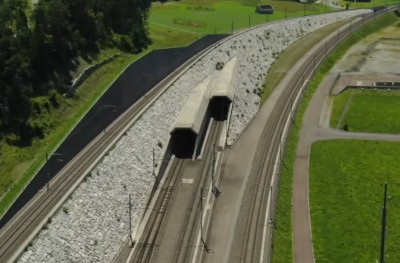
Completed in 2016, Switzerland's 57 km/35 mile long Gotthard Base Tunnel is the world's longest rail tunnel.
The world's 2nd longest railway tunnel is the 34 km/21 mile Lötschberg tunnel under the Bernese Alps.
Ingenious Spiral Loops and Tunnels

Switzerland has more spiral loops and tunnels than any rail system in the world, allowing a standard adhesion-train to climb very steep terrain.
Many of these spirals are built entirely inside mountains as tunnels.
Award-winning bridges
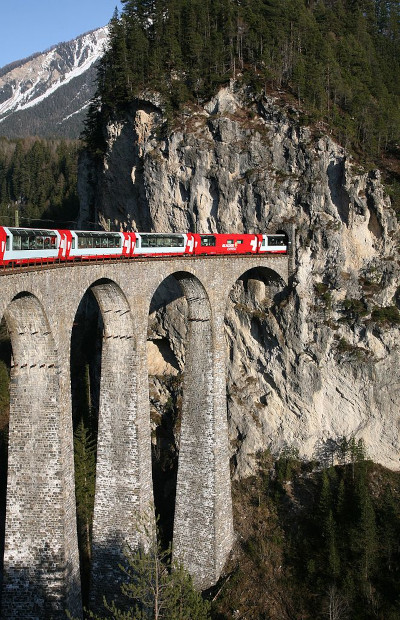
The construction of railway lines in Switzerland necessitated the building of thousands of railway bridges to span rivers and deep gorges.
Masonry, iron truss or concrete bridges used latest engineering technology; most are still in use today, many without need of renovation since their construction.
World's Steepest Cogwheel Train
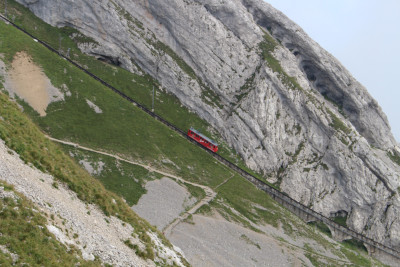
When it opened in 1889, the Mount Pilatus railway was the world's steepest cogwheel railway, and that distinction it still holds today, 135 years later.
Traditional trains have a maximum gradient of 7%; the Pilatus Railway has an average gradient of 35% and a maximum of 48%.
World's Longest Passenger Train
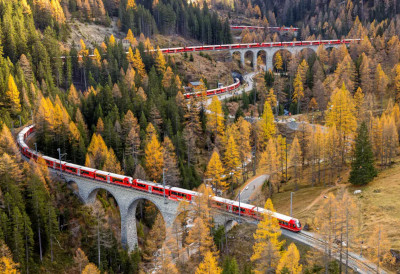
To celebrate the 175th anniversary of its founding, the Rhaetische Bahn (Rhaetian Railways) connected together 25 modern Capricorn engines and 100 carriages. The resulting train measured 1,910 meters in length or 1.2 miles.
In railway history, there has never been a longer passenger train that traveled on mountainous terrain. The railway was set in motion like a giant caterpillar and at a speed of 30 to 35 km/h, the Rhaetian Railway train negotiated some 789 meters of altitude from Preda via Bergün to Alvaneu.
The world-record attempt took place on October 29, 2022, and lasted roughly 46 minutes. Consequently, it was entered into the Guinness Book of World Records.
Railways are not a state monopoly
There are 74 railway companies operating in Switzerland; however, most are small single-track mountain railways.
3 major companies operate most of the commuter and inter-city services:
- SBB - Swiss Federal Railways
- BLS - Bern-Lötschberg-Simplon Railway
- SOB - South-East Railways



The SBB Clock on all railway stations
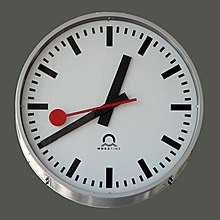
The iconic railway clock was designed in 1944 by SBB engineer Hans Hilfiker; he added the red 2nd hand in 1953 in the shape of a train dispatcher's baton.
The clock stops for just over a second at the end of each minute, to wait for a signal from the master clock to set it going again — to keep all station clocks synchronised.
Swiss trains always leave the station on the full minute. All the clocks at a railway station have to run synchronously so as to show reliable time for both passengers and railway personnel anywhere on or around the station.
Station clocks in Switzerland are synchronized by electrical impulse from a central master clock (at Zürich HB) at each full minute, advancing the minute hand by one minute. The second hand is driven by an electrical motor independent of the master clock. It requires only about 58.5 seconds to circle the face, then the hand pauses briefly at the top of the clock. It starts a new rotation as soon as it receives the next minute impulse from the master clock.