
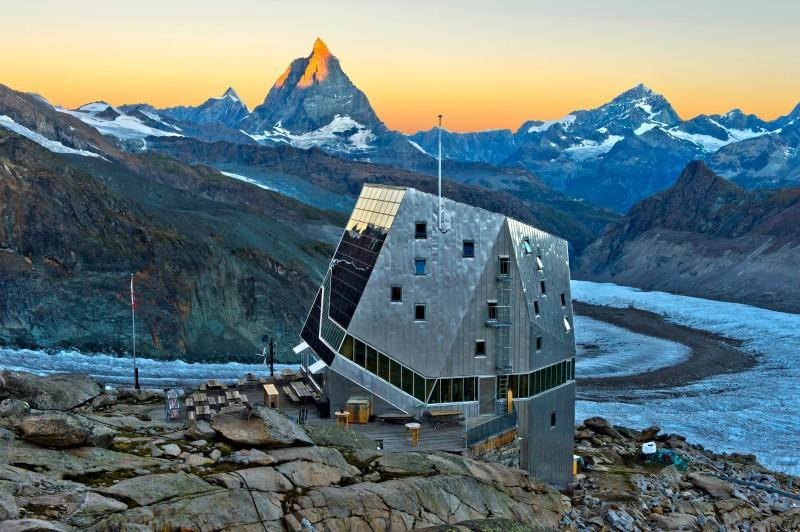
How to find it
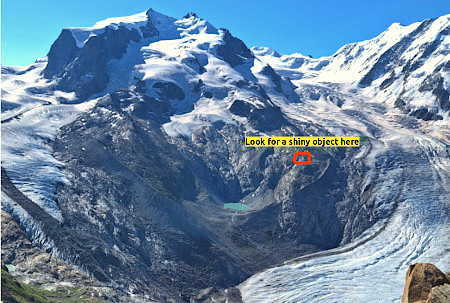
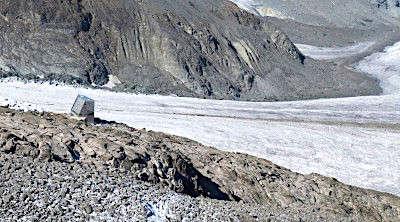
When standing at the Gornergrat station, look for the lake below the Monte Rosa peak, go up the ridge at 2 o'clock and look for a tiny shiny object. This is what the building looks like from close up

When the old Monte Rosa Hut that dated from the 1890s was finally declared no longer fit for use, it was agreed that a new Alpine hut would have to be built from scratch.
Co-incidentally the Department of Architecture at the Swiss Federal Institute of Technology (ETH) in Zurich was looking for a worthy major project to design in celebration of its 150th birthday. The resulting collaboration between the ETH and the Swiss Alpine Club SAC created a remarkable building.
The design process began in 2004 and the hut was opened for guests in July 2010.

It is situated at 2'883 m (9'460 ft) above sea level and has to operate under extreme climatic conditions.
ETH Architecture Prof Andrea Deplazes led a multi-disciplinary team of professors and students to design a building that is considered Switzerland’s most complex wooden structure. The 5-story polygonal building was built on stainless steel foundations; it has a spiral interior and staircase of wood. It was constructed in modules that were helicoptered to the site to be fitted together in situ.
Today the building continues to serve ETH researchers in energy and building technology.
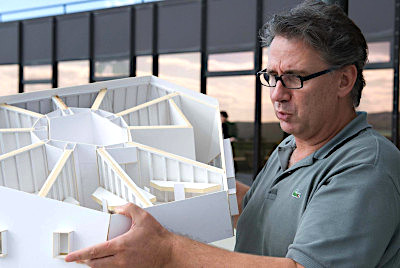

The interiors are made out of wood offering a warm and welcoming ambiance.
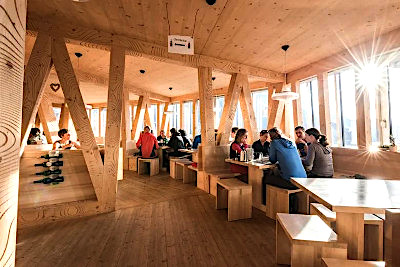
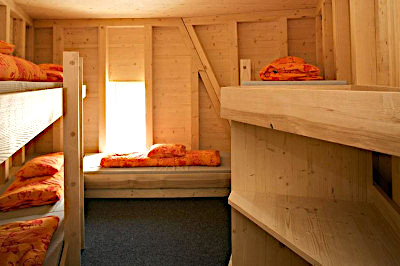
The building can accommodate 120 overnight guests distributed in 6,7 and 8 bed bedrooms split over three floors.
The exterior is covered with an aluminum shell that has photovoltaic systems integrated into the south facade, as well as thermal solar collectors, making it over 95% self-sufficient in energy; excess energy is stored in batteries.
Bands of windows allow the sun to heat air inside the spiral building with the redistribution of thermal energy produced by visitors.

The meltwater that accumulates during a few months of the year is collected and stored in a rock cavern 40 metres above the hut.
A bacterial microfilter system purifies the waste water; the gray water is reused for flushing the toilets.
In order for the hut to achieve such a high degree of energy self-sufficiency, the individual components need to work together as well as a sophisticated energy management system. This is achieved using software developed at ETH Zurich which controls the building services.
