Basic info for the day
- Today is a real scenic railway highlight - 8 hours on the famous Glacier Express travelling through the roof of the Swiss Alps from St Moritz all the way through to Zermatt and the Matterhorn.
- The journey goes across 291 bridges, through 91 tunnels and over the Oberalp Pass at the highest point at 2,033m (6,670 ft) in altitude. The entire line is a narrow gauge railway, and large portions of it use a rack-and-pinion system both for ascending steep grades and to control the descent down the other side.
- The end of the line is the town of Zermatt, the rival resort to St Moritz.
- Stay in Zermatt for next 2 nights.
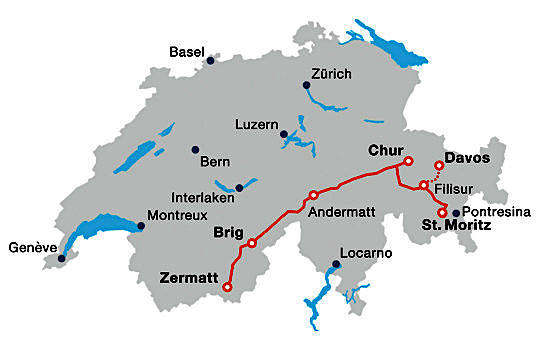
Glacier Express - St Moritz to Zermatt
Route highlights
The train's name honours the Rhone Glacier, located near the town of Gletsch on the Furka Pass; unfortunately this is no longer visible as the train route now uses the Furka Base Tunnel to enable it to run year-round.
The service began in 1930 once all the bits of railway lines around the inhabited places along the route had been joined up. The train travels a distance of 290 kms (180 miles) on narrow gauge and mostly single track; the steepest parts of the journey is cogwheel-assisted.
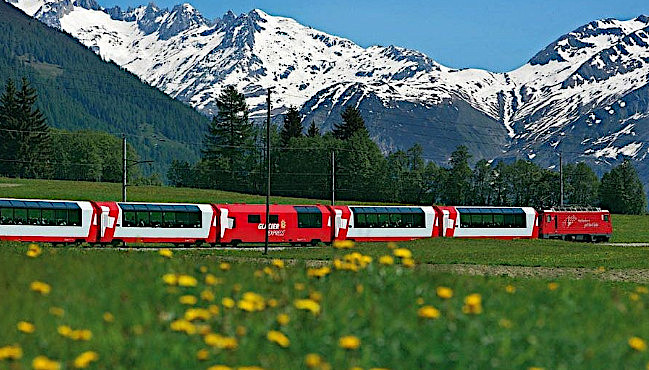
These are the highlights of the route:
Albula Line - 63 km (39 miles) long - the 2nd railway line recognised as a UNESCO World Heritage Line (the 3rd is in Austria).
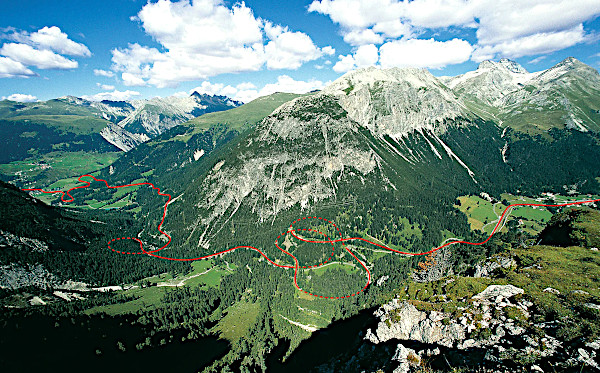
After passing through the Albula Tunnel at 1'815 m (5'955 ft) the distance as the crow flies from Preda to Bergün is just 6 km (3.73 miles), but the train travels twice that distance because in order to descend the 418-m (1'371 ft) difference in altitude, it has to travel through 5 spiral tunnels and looping viaducts.

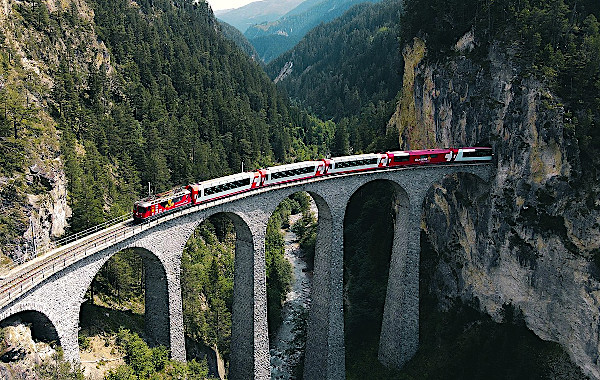
Landwasser Viaduct - the most spectacular construction on the Albula line. Completed in 1903, it is 142 m (425 ft) long and stands on stone pillars 65 m (213 ft) high that were built without scaffolding.
After a brief stop at Filisur, the train enters a tunnel before it passes over the elegantly curved stone viaduct that is linked directly at the tunnel exit. Just after Filisur, make sure to be on the left-hand side of the train and look down.
Rhine Gorge - the “Swiss Grand Canyon” -where the River Rhine has carved a path through a blockage caused by a mountain collapse 10,000 years ago.
Disentis - dominated by the oldest Benedictine monastery in Switzerland dating from the 900s AD; the buildings and church we see were built in the late 17th century; today it is a school. Here the train stops to attach a locomotive with cogwheel drive to assist with the climb up to the Oberalp Pass.
Oberalp Pass - 2'033 m (6'668 ft) - the highest point on the route. Look out for the little lighthouse. Spectacular scenery as the train makes its way down to Andermatt at 1'447m (4'747 ft).
Furka section - the watershed between North flowing and South flowing river systems - and source of 4 of Switzerland's major rivers - the Rhine, the Rhone, the Reuss and the Ticino.
Since the 1980s the line goes through the Furka Base Tunnel. The mountain pass road partially visible before entering the tunnel, is where the iconic car-chase scenes in the James Bond movie "Goldfinger" were filmed in 1964.
As the train exits the Furka Tunnel it emerges in a new canton, Valais; the Goms Valley is the uppermost valley of the Rhone River with traditional timbered dwellings. The village of Niederwald is the birthplace of César Ritz (1850-1918), founder of the Ritz-Carlton Hotel empire.

Matter Valley - after turning left at Visp, the train enters the narrow 25 km (15.5 mi) long Matter Valley following the wild River Matter-Vispa. Here are high peaks, deep ravines, rugged rockfaces, high Alpine meadows and the highest-altitude vineyards in Europe. The train climbs steadily on the steepest section of the whole route before arriving in Zermatt at 1'616 m (5'302 ft).
At Randa you get a glimpse of the Bies Glacier - the only glacier still visible from the Glacier Express train.
Key info on ZERMATT
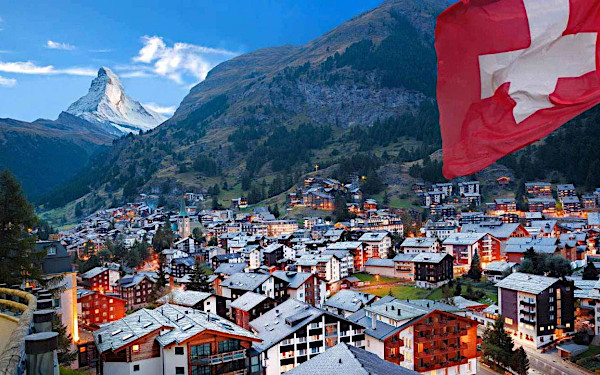
Population - Year-round 5'800; after Swiss-German, 2nd most spoken language by the locals is Portuguese.
Location - In the Pennine Alps, near the Italian border, the southernmost German-speaking town in Europe. Surrounded by more 4'000 m (13'000 ft) peaks than any other town in the Alps.
History - A small self-sufficient Alpine farming hamlet since Roman times until 18th century Romantic writers inspired an interest in the unspoilt mountain beauty, and later mountain climbers came to claim the first ascents of the high peaks.
1865 - 1st ascent of the Matterhorn by British climber Edward Whymper and 6 others, 4 of whom lost their lives on the descent. Despite the tragedy (or because of it?), a rush on the mountains surrounding the village followed, leading to the construction of many hotels and tourist facilities.
Gornergrat Rail - Opened in 1898, the first electric rack railway in Switzerland. It is the highest elevation open air railway in Europe; it ascends from Zermatt to the summit of the Gornergrat at an elevation of 10,135 ft.
Ski Resort - Zermatt is Switzerland's largest ski resort based on lift tickets purchased.