
Basic info for the day
- Spend the morning exploring the village of Gruyeres - visit its 800-year-old Castle and its interesting collection of museums - the Tibetan Museum displayed in an old Catholic chapel, and next door the HR Giger Museum of Fantastical Art (a eye-opener of a museum for such a quaint little village)
- In the afternoon, sit back in the GoldenPass train as it travels along alpine valleys, past rolling hills, beautiful green pastures with grazing cows, wooden chalets and picturesque villages.
- Although the railway track is narrow gauge for half the journey and standard gauge for the other half, innovative gauge-changing technology enables the train to switch from one gauge to the other without the need to change trains.
- At Interlaken Ost change to the local train to Grindelwald, one of Switzerland's oldest and most popular resorts in the UNESCO World Heritage Jungfrau region.
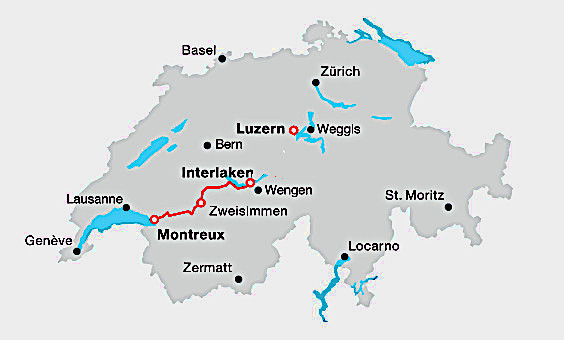
GoldenPass Express

The latest in the list of panoramic train journeys through Switzerland, in operation in this form since Dec 2022. The train runs from Interlaken all the way to Montreux in 3 hrs 15 mins, and finally links the Bernese Alps region to Lake Geneva without the need to change trains.
The idea to link the 19th century tourist hotspots of Lake Geneva with Gstaad and on to Lakes Thun and Brienz was first proposed in 1873, but differences in railway gauges and electricity systems prevented this from happening.
140 years later, using cutting-edge variable gauge technology, the new direct train overcomes the challenges of 2 different track gauges in both height and width, and variances in voltage requirements. Where previously travellers had to change trains at Zweisimmen, now they remain seated in the train as it slows down to 15 km/h and the wheelbase expands or contracts to fit the new gauge as the train passes over the gauge-changing mechanism.
The complex wheel structure beneath each carriage can also raise the body height to meet the higher platforms of the stations along the standard gauge line, or vice versa along the narrow gauge route, so elevating or lowering the coach from 35cm to 55cm (13.7 to 21.6 inches) in a few seconds, making this a world-first feature.
Key info on GRINDELWALD
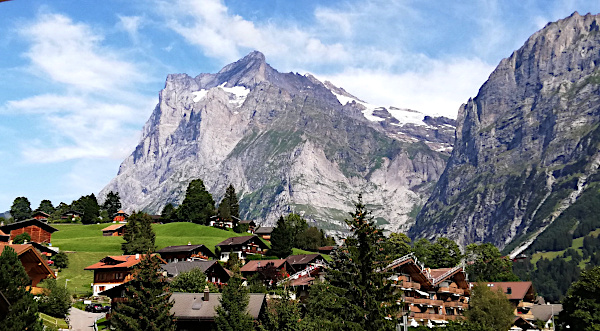
Situation: 1'034 m (3'392 ft) above sea level;
Population: year-round approx 4,500 of which 18% are resident foreign nationals.
History: 1st settlers were Celts in 1C AD; thereafter for centuries a poor farming community until the 19th century "Golden Age of Alpinism" when wealthy tourists "discovered" its close proximity to high Alpine peaks and glaciers. From 1830 to 1860 it transformed rapidly from rural backwater to fashionable international resort when road and rail links to Interlaken were constructed.
Glaciers & the ice trade: Glaciers once reached so far into the village that there were fears it would be crushed by the ice. Locals took advantage of this - they cut blocks of ice from the glaciers and transported them to Interlaken and on to Paris & Vienna. The First World War and artificial ice killed the trade.
Tourism put Grindelwald on the map, not for what it offered but for where is was. The sheer accessibility of the glaciers brought tourists to Grindelwald - 150 yrs ago 2 glaciers were just a mile away or within walking distance.
Today tourism is the town's main industry which indirectly ensures all other businesses thrive.
Mountains surround the town, 2 peaks in particular are dominant:
Eiger 3'970 m (13'000 ft) - first climbed in 1858; its North Face route is most dangerous in the whole Alps and only climbed for the first time in July 1938 by a German & Austrian team over 4 days.
Wetterhorn 3'692 m (12'112 ft) - 1st climbed by local mountaineers in 1844; 1866 Lucy Walker was 1st woman at the top; 1894 Winston Churchill climbed it. 1904 world's 1st cable car was installed; the plan was for 4 stages - a true wonder of modern technology at the time, but only first stage was actually constructed and operated 1908 to 1914 when tourism was killed by the First World War and the project collapsed.
Ski resort: 1881 the first person to ski in Grindelwald was Englishman, Gerald Fox; he put on his skis in his hotel bedroom and walked out through the hotel bar to the slopes wearing them.
James Bond film "On Her Majesty's Secret Service" includes a chase through a skating rink and a Christmas festival in Grindelwald that was specially held for the film.

Wetterhorn & world's first cable car (1908)