
Origins
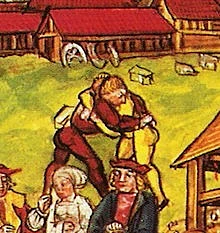
These are not clear but probably derived from Graeco-Roman wrestling; there are records of wrestling in Switzerland from the medieval period.
“Schwingen” became an integral part of festive culture from early 17thC. At Alpine festivals, people would wrestle for a piece of trouser-cloth, a sheep or other natural objects - the fame of victory counted for far more than the actual prize - still the case today.
In 19thC, “Schwinger festivals” and sports teachers brought “Schwingen” from the countryside to the cities so a national sport that reached all social levels developed out of the traditional strength contests of shepherds and farmers.
Rules of the tournament
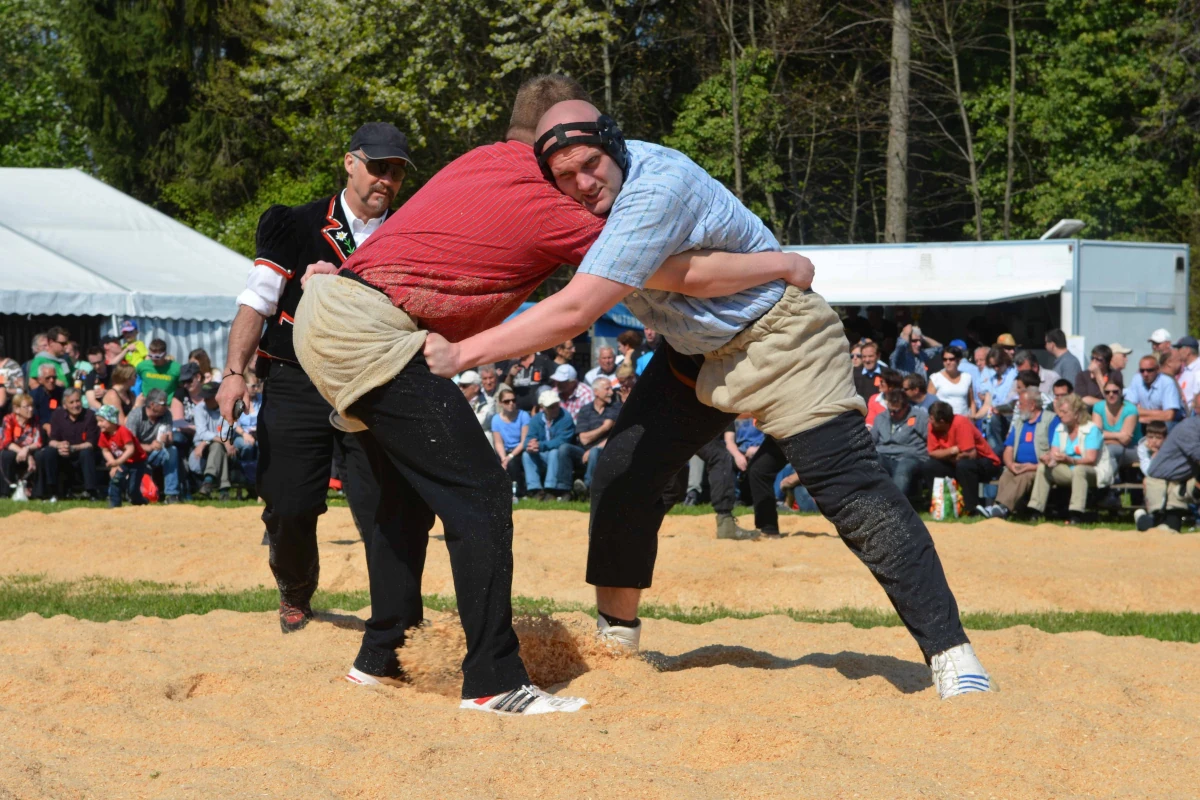
- Matches take place in a 12 m diameter circular area covered with sawdust.
- No aids are allowed during the fight.
- The wrestlers wear special Zwilchhosen (shorts) made out of a robust and strong fabric - with leather "handles". The fabric is specially made; only 3 or 4 places in Switzerland still sell it.
- The wrestlers hold each other at the back where the belt meets.
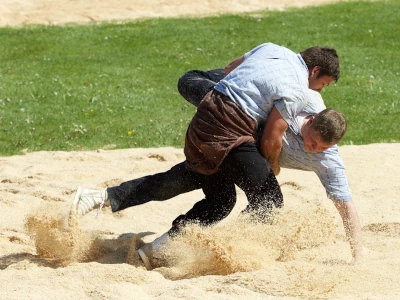
- Using only bare hands, wrestlers try to turn opponent onto his/her back - first person to pin his/her opponent's shoulders to the ground wins the bout.
- There are around ca. 100 different movements and 5 main throws - very similar to judo techniques.
- A match is won when the winner holds the opponent's pants with at least one hand and both the opponent's shoulders touch the ground.
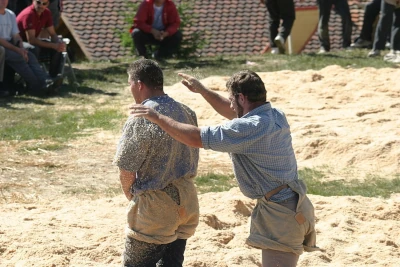
- By tradition the winner brushes the sawdust off the loser's back after the match.
- The match is judged by 3 referees, one of whom stands in the ring. The referees give points, max. is 10 points for a winning throw.
- If a match ends without a clear win, the more active Schwinger is awarded the higher number of points.
- At regional Schwing festivals, every Schwinger wrestles 6 opponents, 8 at the Eidgenössische (national level).
- The 2 Schwingers with the highest number of points after 5 matches (regional) or 7 (Eidgenössische) level get to the Schlussgang (last round).
- There are no weight classes nor any other categories, Schwingers are usually big people - men over 180 cm tall and weighing in excess of 100 kg; they mostly practice traditional professions that require physical force, like carpenters, butchers, lumberjacks, cheesemakers.
- Regional and cantonal Schwing festivals are held outdoors, between early summer and autumn.
- The most important Schwing festival is the Eidgenössisches Schwing- und Älplerfest, which takes place every 3 years (next one in 29-31 Aug 2025). The winner of this tournament is proclaimed Schwingerkönig (King of Wrestling).
The Big Prize for the King
The prize for the "King of Wrestling" (the only "King" in Switzerland) is not a silver trophy or prize money but a live bull called a Muni. What the king does with it is up to him. More lucrative are the advertising contracts that the Wrestling King gets ...
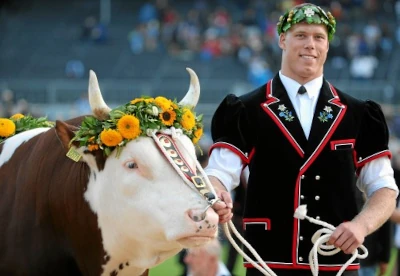
Traditions
- Advertising and sponsoring at the festivals is shunned. Successful Schwingers do not receive cash prizes, but goods such as cowbells, furniture or livestock.
- The best Schwingers at a festival are awarded a wreath.
- Good Schwingers at national level are called "Böse" (wicked).
- Schwingers who receive a wreath at an Eidgenössische or national tournament are called Eidgenossen (confederates).
- A winner of the Eidgenössische is given the lifetime title of Schwingerkönig (Schwinger King), which includes privileges like being a guest of honor at every future Eidgenössische.