
Basic info for the day
- Take a local train to Stans, capital town of the neighboring Canton of Nidwalden.
- Ascend to the top of the 1'900 m (6'230 ft) Stanserhorn peak, at first via a historic funicular and then riding the unique CabriO double-decker open-top cableway.
- At the top, enjoy the beautiful panorama of the Central Swiss Alps and Lake Lucerne below. Take a short walk to the 360º viewing platform and a chance to meet the marmots that make their home here.
- Dinner and fun folklore show at the Stadtkeller ends the first day of the tour.
Key info on STANS
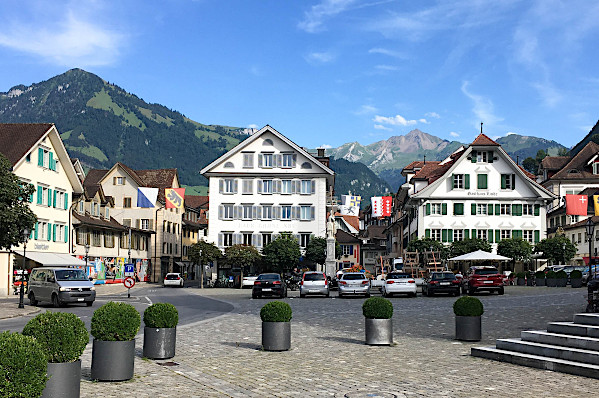
Stans is one of the oldest settlements around Lake Lucerne with traces of humans from 2nd century BC. During the 7th/8th century, the Christian Alemanni settled in the region. Stans was first mentioned as a formal settlement in 1124.
13th century - Stans was the capital of the area known as 'Unterwalden nid dem Kernwald' which would become the half canton of Nidwalden (NW) - the other half is Obwalden (OB) - meaning "below" and "above the forest" - and together they are known as Unterwalden. Unterwalden is one of the 3 founder cantons of the original old Swiss Confederation dating from 1291.
In 1386, during the Battle of Sempach, according to legend, a soldier from Stans, Arnold von Winkelried, threw himself on the pikes of the Habsburg army which allowed the Swiss to break through their rank to claim victory, and Winkelried became a Swiss hero.
Following the Swiss victories in the Burgundian Wars, the Old Swiss Confederation was nearly torn apart by internal conflict over dividing up the spoils of war. The leaders met in Stans in 1481 but the issues remained intractable and war seemed inevitable until a local hermit, Bother Niklaus von der Flüe, sent a message to the leaders. The details of the message remain unknown, but it did calm the situation and led to the drawing up of the Stanser Verkommnis, as part of which Fribourg and Solothurn were admitted as new cantons in the Swiss Confederation.
Nidwalden and Stans are known as being very "traditional and conservative". In 1789 it refused to adopt the constitution of the Helvetic Republic imposed by Napoleon, and as a result was stormed by French troops with large loss of life.
Stans was transformed in the 20th century by transportation links to other centres - steamship then railway and from 1966 the A2 motorway, Switzerland's main north–south axis from Basel to Italy.
Stanserhorn
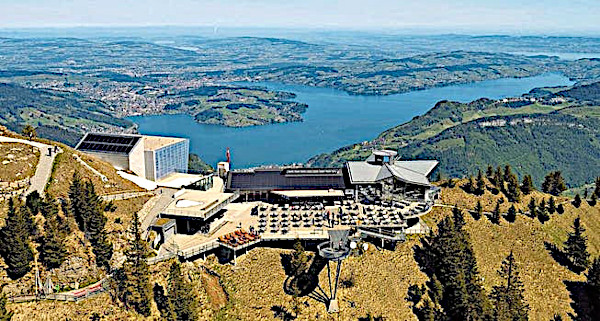
Stanserhorn is the "little brother" of Mt Pilatus with its peak reaching 1,898 metres (6,227 ft) above sea level or just 230 m (750 ft) less than Pilatus. It is accessed via one of the oldest mountain railways in Switzerland, the Stanserhornbahn dating from 1893, and by a unique open-deck cable car.
The railway was the brainchild of local carpenters Franz Josef Bucher-Durrer and Josef Durrer-Gasser who built a hotel on the peak after they had seen the immediate success that tourism had brought to neighboring Mt Pilatus.
To get their guests up to the hotel they built the railway using cost saving measures such as a self-developed pincer brake system which was more effective and cheaper than the cogwheel brakes commonly used at the time. The hotel burnt down in the 1970s but the lower part railway was saved, and an aerial cableway replaced the top section.
Take a 9 min ride on the original but restored wooden funicular wagons to the Kälti intermediate station and then change to the "CabriO" cable car for a 6 min ride to the top.
There is a revolving restaurant, souvenir shop, sun terrace and observation deck at the summit. On a clear day 10 lakes in total are visible as well as views as far as Alsace and the Black Forest in Germany.
Take a 30 min round trip walk around the summit and a 10 min walk up to the actual peak at 1,898 metres (6,227 ft) altitude where a small population of marmots are kept near the trail.
See also