
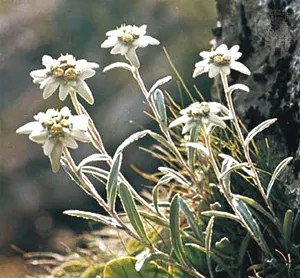
Edelweiss facts
The Edelweiss belongs to the Daisy or Sunflower family (Asteraceae).
Each flower has 5 to 6 small yellow clustered spikelet-florets (5 mm, 3/16 in) surrounded by fuzzy white "petals" (technically, bracts) in a double star formation.
It grows to about 20 cm (8 inches) the the wild in rocky limestone places between 1,800-3,000 metres (5,900-9,800 ft) altitude; in cultivation it can grow up to 40 cm (16 inches).
It is fertilised by flies; its flowers bloom between July and September.
Its leaves and flowers are covered with white hairs that protect against cold, aridity and ultraviolet radiation of high altitudes.
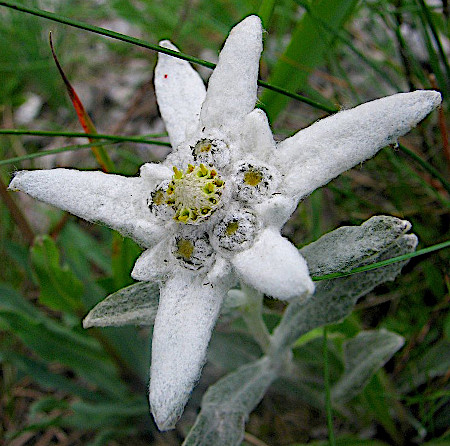
Early-season with central floret-pods not yet fully developed.
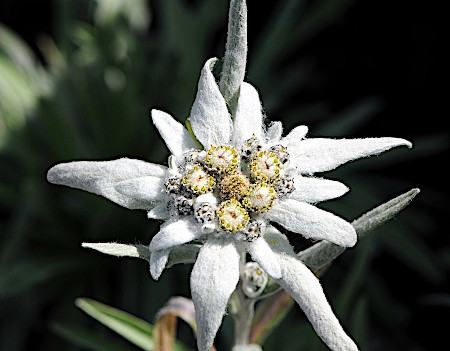
Typical mid-season appearance.
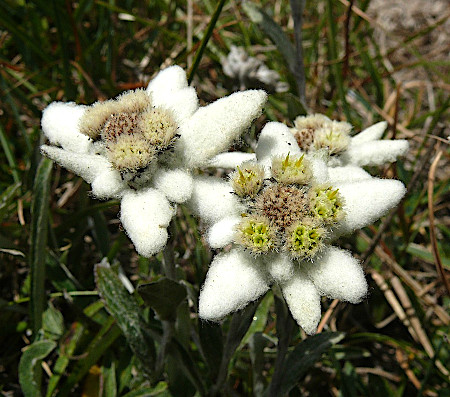
Late season with "fat" appearance from flowered-out central floret-pods and from longer petal-"fuzz
More Edelweiss facts:
The Edelweiss "migrated" to Europe during the ice ages; it originally came from the high plateaux of the Himalayas and Siberia where about 30 little-known species are to be found.
'Edelweiss' is one of several regional names for the plant; it was largely unnoticed until the first half of the 19th century when early Alpine tourists adopted it as a symbol for the rugged beauty and purity associated with the Alps.
It is now a protected plant in many countries - Mongolia, Bulgaria, Croatia, Switzerland (since 1878), France, Norway, Iran, India, Italy, Serbia, Malaysia, Indonesia, Germany, Spain, Poland and Slovakia, Slovenia, Austria and Romania.
It is the national symbol of several countries - Bulgaria, Austria, Slovenia, Italy, Romania, and of course, Switzerland, and features in the coat of arms of many towns and cities.
It forms the logo of numerous Alpine clubs right across Europe as well as the Union of International Mountain Leader Associations; it is also a rank insignia of units in the French and Austrian armies and the Swiss military.

Many legends are associated with the plant - such as that of a bold suitor who put his own life in danger climbing a steep rock face to pluck the white flower as a gift for his beloved - from which arose the folklore belief that giving this flower as a gift to a loved one is a promise of 'dedication'.
The Edelweiss has a dark past - it was the favourite flower of Adolf Hitler and was used as a symbol by the Nazis - in 1935, German Wehrmacht formed an alpine unit which used the flower as part of the insignia on its uniforms.
Towards the end of the WW2 the Edelweiss became the symbol of the German resistance against Nazism - “Edelweiss Pirates” were groups of young workers who were active as urban guerrillas against the Nazi regime.

Today the Edelweiss is particularly in demand from the cosmetic industry. It is non toxic, and has been used traditionally in folk medicine as a remedy against abdominal and respiratory diseases.